
When a Wire Core Is Not Enough
Most people picture an automotive seal core as the coiled steel wire inside a weatherstrip extrusion. That wire core serves extruded profiles beautifully, but it has one weakness: it is a coil, and a coil resists linear clamping load with limited flexibility in torsion. Seals that must bend repeatedly through their service life — convoluted boots, complex window channels, secondary seals that flex with every door opening — need a core that behaves like a rope: strong in tension, flexible in bending, resistant to twist. That is the woven, or braided, steel core.
How a Woven Core Is Built
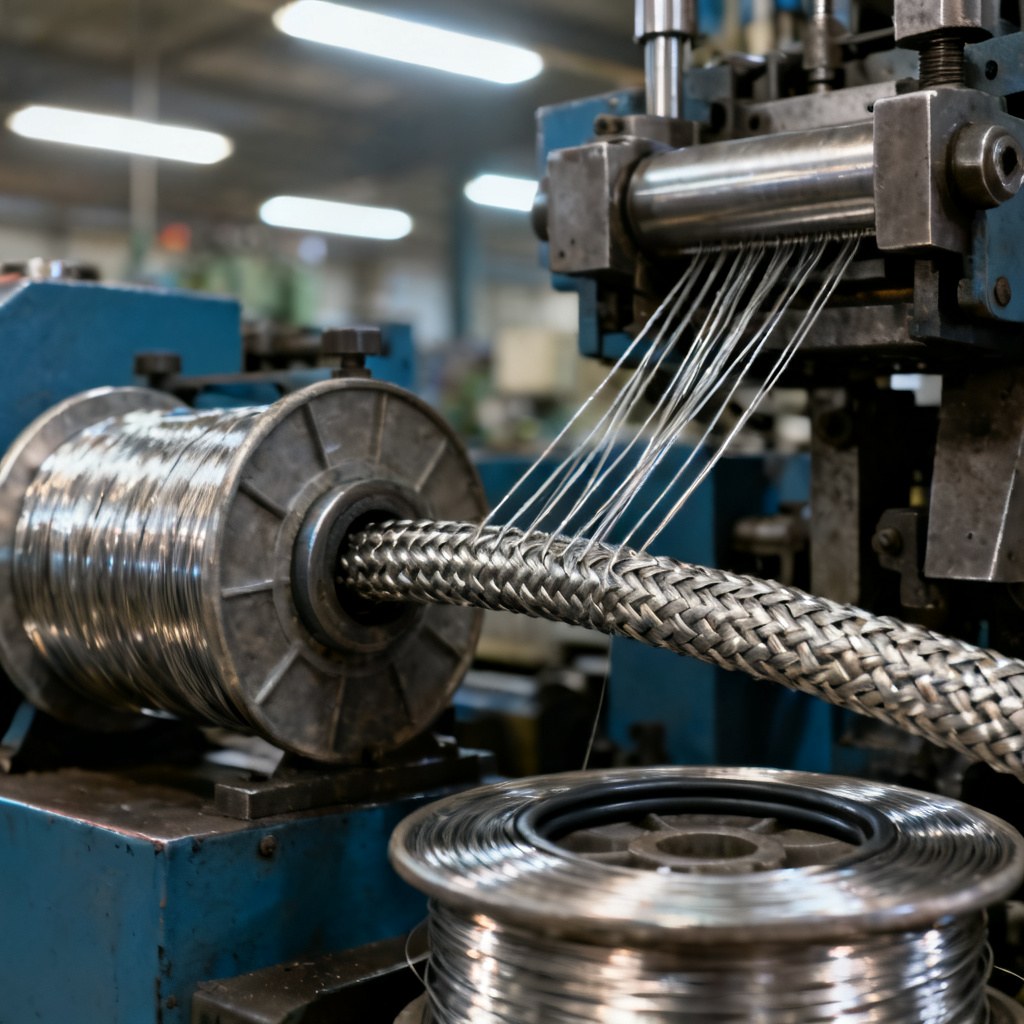
Woven cores are made on braiding machines: multiple strands of fine steel wire — typically 0.1–0.3 mm individual wires — are interwoven in an over-and-under pattern around a center, forming a tube or rope. Because every wire changes direction continuously, the structure carries load along whatever path the seal takes. Two shapes dominate:
- Round woven cores: braided tubes or solid ropes, cut to length and used as reinforcing members inside molded or vacuum-formed rubber parts.
- Flat woven cores: slightly flattened braided bands, positioned between rubber layers in laminate seals.
After braiding, the core is washed to remove drawing compound, coated (zinc or phosphate systems are common) to promote rubber adhesion, and supplied on spools or cut sticks to the molder.
Where Woven Cores Are Used
| Application | Why the Woven Core Wins |
|---|---|
| Convoluted boots & bellows | Bends thousands of times; the rope-like core survives the flex |
| Glass run & window channel seals | Handles channel curves without taking a set |
| Secondary body seals | Mechanical retention in closed sections without cracking rubber |
| Fuel line & hose reinforcement | Controls burst strength and kink resistance |
| Laminated/consolidated seals | Flat band adds strength through curved laminate sections |
Woven vs. Wire Core: Different Physics
The rolled wire core in an extrusion works because a coil can give and take with a straight profile. Put the same coil into a convoluted curve and individual turns can lock against each other, the rubber around it thins at bend apexes, and eventually the coating cracks or the core kinks. A woven core distributes flex across hundreds of small wires moving relative to each other in the braid — the same reason a stranded cable survives bending that a rod would not.
What to Specify
- Wire spec: diameter, grade (carbon or stainless), and tensile of individual strands — this sets break force.
- Braid density: picks-per-inch, carrier count, and lay direction; these govern compaction, elongation, and coverage.
- Dimension and shape: nominal diameter or width, plus allowable ovality or flattening.
- Coating/adhesion system: brass-plated and zinc-organic systems are typical for rubber bonding; match to the intended compound.
- Length supply form: continuous spool or pre-cut sticks for multi-cavity tools — the cut form eliminates trimming time and molder labor.
- Documentation: break load per lot, coating mass, and adhesion pull results alongside material test reports.
Join and Termination
Woven cores face challenges that wire cores do not: raveling at cut ends. Cut lengths need capping, tipping, or bonding station treatment, and cores that enter a spool or mold under load may need swaged fittings. Where a woven core transitions to a metal insert, specify the clamping method — a threaded or crimped sleeve keeps the rope from pulling free under load.
Keep the Core Breathing
When core specifications are reviewed early, most problems come from the adhesive side. A woven core is only as good as the bond around it; design the rubber housing to encapsulate each wire, and qualify the adhesion system with the actual compound, cure schedule, and mold-release package in play. Hold-Tech works with seal designers on core selection — woven, stamped, or rolled wire — and supplies to the documentation your PPAP file needs. Send the seal section drawing and expected flex cycling to operator@hold-tech.cn or call +86-186-60386138.