
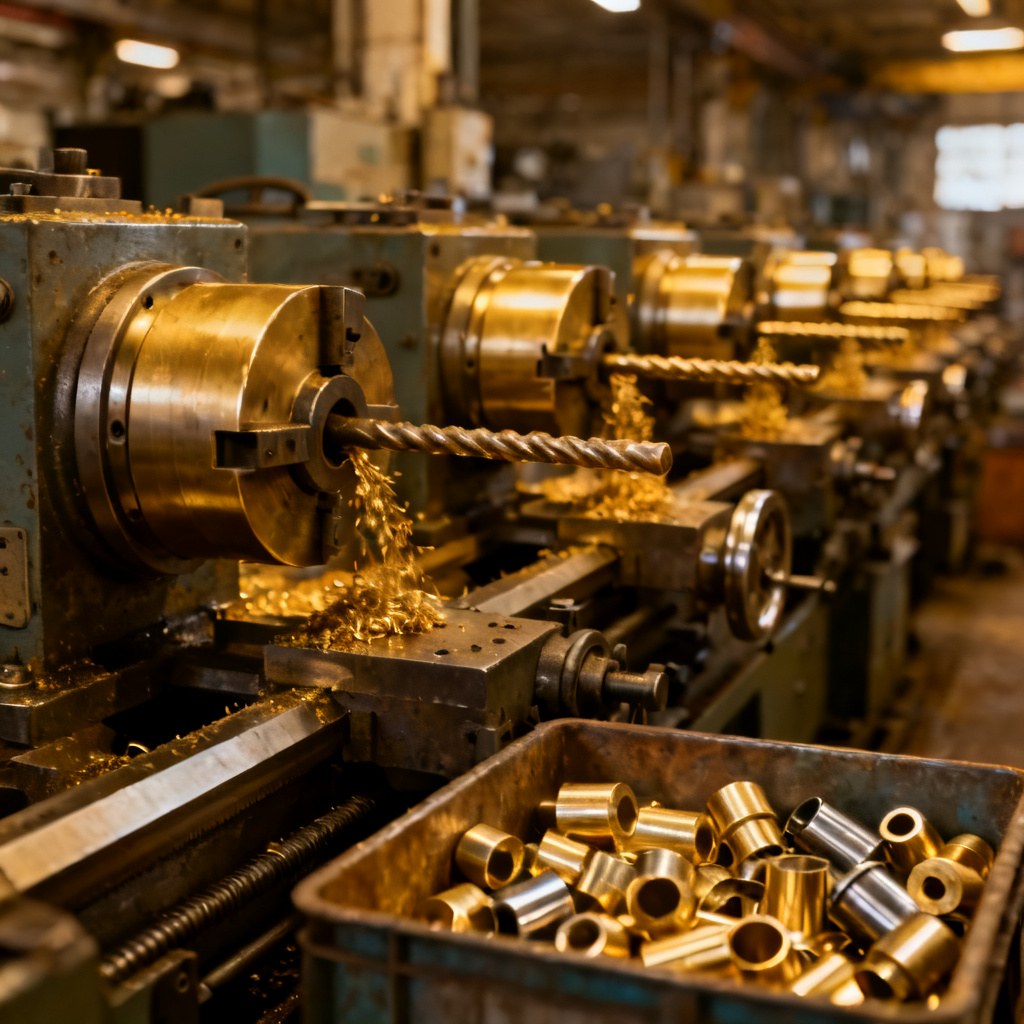
The Unsung Machines of Volume Production
Every car, appliance, and connector system on earth contains dozens or hundreds of small turned components — pins, shafts, spacers, bushings, screws, sleeves, and terminals. Most of them were not made on a CNC lathe, one at a time with a programmer involved. They were made by cam automatic lathes — “cam lathes”, or in older language, automatic screw machines — machines that cycle unattended with cam-driven tool motion, feeding long bars of stock through the spindle and producing parts at a rate measured in pieces per minute.
How a Cam Automatic Lathe Works
Unlike the servo-driven CNC lathe, a cam lathe takes its motion from a rotating structure of cams mounted on a shaft. Each cam pushes the slides in a sequence as the spindle bar advances — turning, facing, grooving, cutting off, and repeating. Tool selection, timing, and rod feed are all set mechanically: cams are shaped, not programmed. A toolmaker adjusts cam geometry until each motion runs true, and then the machine repeats those motions precisely for as long as stock feeds.
Why It Survives Beside CNC
Modern CNC lathes and cam automatic lathes overlap, but neither replaced the other. The reasons are simple:
- Cycle time per piece: cams can overlap cuts so that tool motion is pure sequence — bar feed, index, cut, cut off — with no dwell for interpreter commands. For very small parts on series, cycle times can be counted in single-digit seconds.
- Autonomy: with a bar feeder and a parts catcher, a cam lathe runs unattended for hours, cutting coils of finished parts at a rate that keeps one operator overseeing a bank of machines.
- Tool life on small parts: cutting is short and consistent; tool loads are predictable; wear happens in ribbon rather than unpredictably, and replacements are quick.
- Repeatability: once the cams are proven, the machine repeats the same geometry part after part, hundreds of thousands of times over.
- Material coverage: cam lathes eat free-machining material — brass, copper, 12L14, 1215, aluminum — at practical speeds where chips curl away cleanly.
What Gets Made on a Cam Lathe
| Part Family | Typical Examples |
|---|---|
| Fasteners & hardware | Shoulder screws, set collars, bushings, threaded inserts, bolts and pins |
| Electrical & connectors | Terminals, contact pins, sleeves, ferrules |
| Automotive | Small shafts, valve pins, sensor carriers, core components |
| Fluid control | Valve stems, needle bodies, fitting bodies |
| Machined assemblies | Rollers, spacers, stands, locator pins, and turned bodies |
The common thread is a simple turning operation on material cut from bar stock — operations a cam sequence can repeat elegantly.
The Limits — and How CNC Fills Them
Cam lathes are best at rotational features along the axis: diameters, lengths, grooves, chamfers, simple profiles. Angular features, flats, hexes, and slots challenge the process: a cam lathe has no programmable milling axis, so any feature requiring one is finished in a secondary operation. Where the part complexity pushes past what cam timing can cleanly produce, or volumes dip to a few hundred a month rather than hundreds of thousands, CNC turning overtakes on economics: CNC setups recover their programming cost when they amortize over a smaller batch.
Choosing Between Cam and CNC
The decision usually comes down to numbers. A cam lathe amortizes cutting-tool and setup work over a large production run; its strength compounds with quantity. For prototype, low-volume, or highly complex rotational parts, CNC turning lowers risk: no cam timers, no fixture investment, and the ability to change the job between batches. For hardened volumes — especially small, simple parts in free-machining stock — the cam lathe's cost per piece keeps winning.
Where Hold-Tech Fits
Hold-Tech Precision Industrial supplies small precision turned components for automotive, electrical, and industrial markets. We run CNC turning and milling, plus cam-automatic-lathe style production for the small simple parts that benefit from economics of volume, and our team will honestly advise which route is right for your quantity and geometry. Send drawings or models with an annual quantity to operator@hold-tech.cn or call +86-186-60386138, and we will quote the right process.