
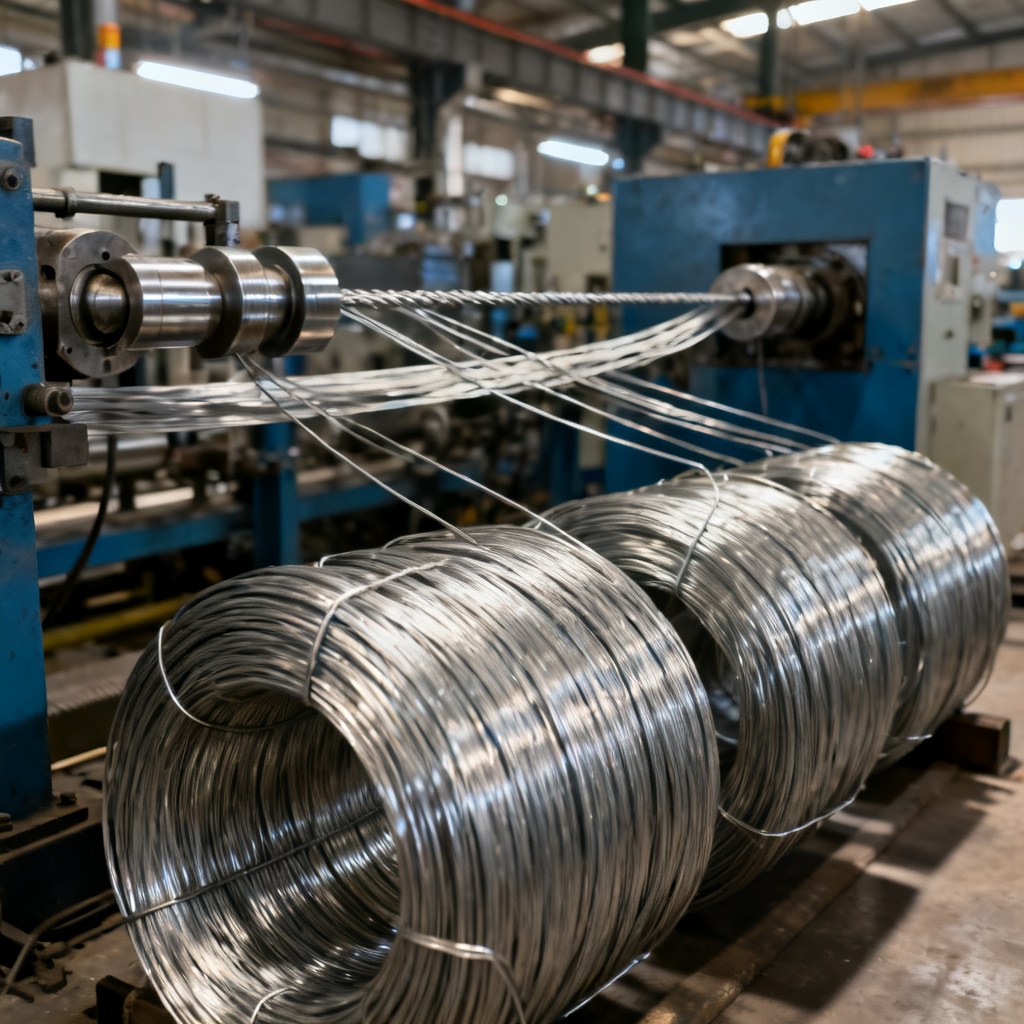
From Rod to Carrier in Six Steps
An automotive seal strip steel core looks simple on a drawing, but it is the product of a controlled sequence of metal forming operations. Each step sets a property that shows up later as clamp load, fatigue life, or corrosion resistance. Here is the standard route.
Step 1 — Wire Rod and Surface Preparation
The route starts with wire rod in the chosen grade. The rod is descaled — usually by mechanical descaling or pickling — and coated with a drawing lubricant or a thin carrier coating so it can pass through the dies without galling. Surface cleanliness here directly affects the final coating adhesion.
Step 2 — Wire Drawing
The rod is pulled through a series of carbide or diamond dies, reducing diameter in stages to the target wire size. Step-drawing (several passes with intermediate anneals if needed) controls diameter tolerance, roundness, and surface finish. For cores, diameter is often held to a few hundredths of a millimeter because it feeds straight into the clamp-load calculation.
Step 3 — Patenting and Tempering
To reach a spring temper, carbon steel is patented — heated and cooled to form the fine pearlite structure that draws into high-strength wire — and then tempered to dial in the strength-versus-ductility balance. This is the step that decides whether the core can be formed into a tight zigzag without cracking and still hold clamp load afterwards.
Step 4 — Profiling: Straight, Zigzag, or U-Form
The drawn wire is formed into the core geometry the seal needs:
- Straight — parallel wires fed as-is.
- Zigzag / sinuous — wire bent into a controlled wave with a set pitch and amplitude.
- U-form — wire pre-bent into the channel that clamps the flange.
- Knitted — wire knitted into a flexible mesh tube.
Pitch, amplitude, and channel width are held to tolerance because they set the seal's grip and bending behavior around the vehicle perimeter.
Step 5 — Coating: Galvanizing and Plating
After forming, the core is cleaned and coated. Electro-galvanizing applies a thin, uniform zinc layer; hot-dip galvanizing gives a heavier, more corrosion-resistant layer. Brass or copper plating is applied where a strong rubber-to-metal bond is required, often over a corrosion base coat. Coating mass and adhesion are checked because a coating that cracks at the profile bends is worse than no coating at all.
Step 6 — Coiling, Inspection, and Packing
The finished core is coiled or spooled in continuous lengths for the extrusion line. At this stage the supplier verifies diameter, profile, pitch, temper, tensile strength, coating mass, and straightness, and inspects for kinks, slivers, and weld quality at coil joints. Cores are packed to protect the coating and to unspool without tangling — a tangle stops the customer's line.
The Controls That Separate Good Cores From Cheap Ones
| Property | Why It Matters | Typical Control |
|---|---|---|
| Diameter / profile | Sets clamp load and fit | In-line laser gauging |
| Temper / tensile | Grip strength and forming | Tensile test per lot |
| Coating mass | Corrosion life | Weigh-strip / acid strip test |
| Coating adhesion | Bond and flake resistance | Bend and tape tests |
| Straightness / camber | Feeds without wandering | Gravity / roller check |
Sourcing a Core You Can Run
Hold-Tech controls the drawing, tempering, profiling, and coating of seal strip steel cores so that what arrives on your dock feeds and performs as specified. Share the profile, material, and coating spec at operator@hold-tech.cn or +86-186-60386138 and we will build a qualification sample for your extrusion line.