
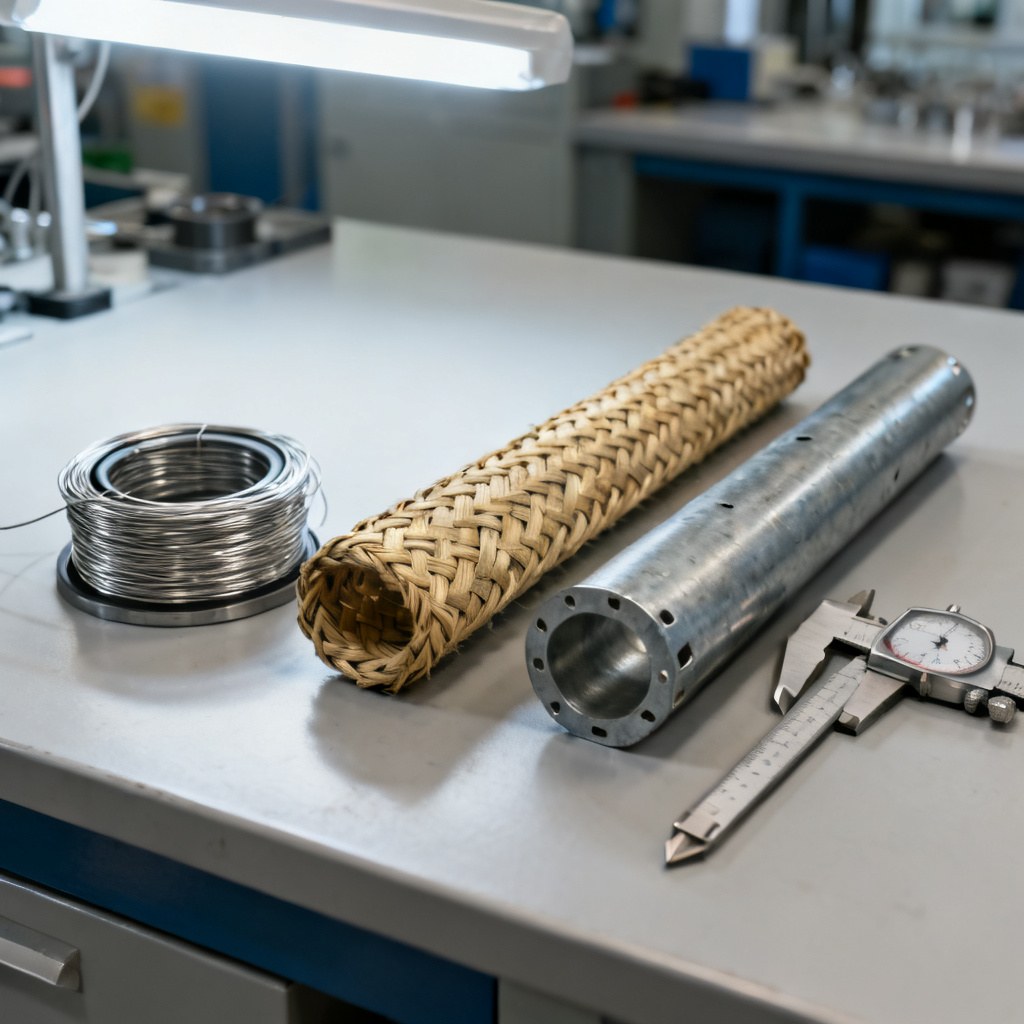
Three Cores, Three Behaviors
Automotive seals are reinforced by three families of steel core, and the choice among them decides not just the seal's mechanical behavior but how the seal can be manufactured at all. Pick wrong and the part either fails in service or becomes unprofitable to produce. The good news: the selection logic is simple once the three behaviors are laid side by side.
The Comparison
| Attribute | Rolled Wire Core | Woven (Braided) Core | Stamped Steel Carrier |
|---|---|---|---|
| Structure | Coiled, formed wire | Interwoven fine wires | Stamped and bent strip |
| Fit with | Extrusion | Molding, laminates, hoses | Mold bonding, channel frames |
| Tensile strength | High along the axis | High, balanced | High, section-dependent |
| Flexibility | Limited; holds a profile | Excellent; bends repeatedly | Rigid; forms the seal shape |
| Torsion resistance | Low | High | Very high |
| Tooling cost | Low; rolling dies | Low; braiding setup | High; progressive dies |
| Ideal volume | Continuous runs | Continuous or cut lengths | Stamped series |
| Secondary machining | None | Cutting and capping | Welding, punching variants |
| Design changes | New profile rolls | Braid parameter change | Die modification |
Choose by the Seal's Birth Process
Rather than asking which core is “best”, ask which process your seal will be born from. An extruded weatherstrip wants a wire core: the forming line pulls the coil through a crosshead while rubber vulcanizes around it. A convoluted boot or hose that bends with every suspension cycle wants a woven core: the rope-like structure survives the flexing that would fatigue or kink a coil. A beltline channel or drip rail wants a stamped carrier: the frame gives the section permanent shape, and bonding holes lock rubber in place during injection molding.
When the Answer Is a Combination
Real seals mix cores more often than clean theory suggests. A beltline seal might use a stamped carrier for the beltline channel plus a wire core at the rubber fin; a door seal might use a woven core in a bellows section and a rolled wire core elsewhere. The design discipline is to treat each independently loaded section as its own core decision, with the transitioning geometry — splices, weld spots, caps — designed before drawings are frozen.
Cost, Volume, and Risk
- Wire cores: minimal tooling, so even small programs can start; process cost drops with continuous run length.
- Woven cores: low tooling as well, but supply form matters — pre-cut sticks shift labor off your molder and reduce scrap, and typically pay for themselves above moderate volumes.
- Stamped carriers: tooling is the largest investment of the three, but it amortizes across high-volume programs and the frame unlocks designs that neither wire nor woven can deliver.
A Selection Sequence That Works
- Define the seal's load paths: what pulls, what bends, what twists?
- Define the manufacturing route: extrusion, molding, or laminate assembly?
- Match the core family to the route: wire for extrusion, woven for flexing molded parts, stamped for framed channels.
- Confirm coating and adhesion against the rubber compound and cure process.
- Agree inspection and documentation for core break load, coating mass, and bond test results per lot.
Talk to the Core Supplier Early
Core selection shapes everything downstream — tooling, molder layout, and the quality plan. Hold-Tech supplies all three core families for automotive seal programs, from single-source coils to stamped-and-welded frames prepped for molding, with the documentation your PPAP file needs. Send your seal section drawings to operator@hold-tech.cn or call +86-186-60386138, and we will walk the options with your service conditions in hand.