
The Skeleton Inside the Seal
Drip rails, beltline channels, glass run channels, and many secondary seals get their shape from a steel core that is not a wire at all. A stamped carrier is a band of steel strip, punched and formed into a skeleton that rubber is molded against. Where an extruded profile relies on a continuous wire, a stamped carrier gives the seal a rigid frame that rubber is injection-molded over, with mechanical retention holes pressed right through the strip.
How the Carrier Is Made
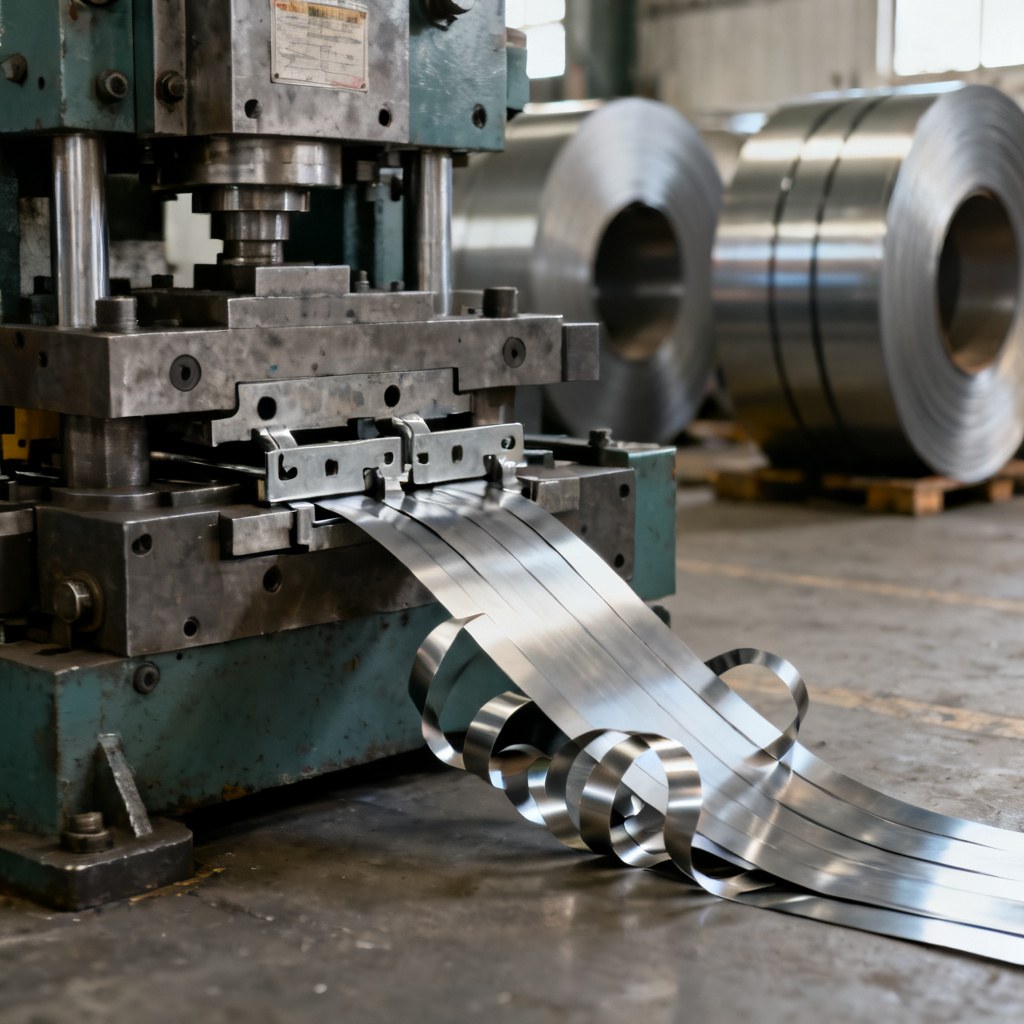
Production starts with cold-rolled or galvanized steel strip, typically 0.3–1.2 mm thick, fed from a coil into a progressive die. Each station in the die performs one operation — pierce the bonding or dog-bone holes, notching corners and ends, forming bends, and finally blanking — and by the time the strip leaves the last station, a carrier with a complex outline exists that no wire ever could. Key process points:
- Bend radii are generous: strip bends with the grain, and tight radii work-harden edges; design to keep them manageable so cracks do not propagate in service.
- Springback is engineered out: overbend compensation and consistent tempers are what keep channels true in curved sections.
- Oil and cleanliness: stripping lubricant before molding is not optional — rust and contaminated bonding surfaces cause mold-bond failure.
Design Features That Do Real Work
| Feature | Purpose |
|---|---|
| Bonding holes (dog-bone / PE eye) | Key into molded rubber, lock against pull-out, provide pass-through for adhesives |
| Tongues and notches | Interlock with corners, control rubber flow in thick sections |
| Spacer ribs | Hold the strip inside a laminate or weld leg at a fixed height |
| Wider flange zones | Give the punch a landing surface and carry fastener or clip attachment loads |
| End attachments | Pre-punched or hemmed ends that splice to adjoining seal sections |
Material and Surface
Carrier steels span standard drawing steel (DC01/ST14), mild and high-strength low-alloy grades (SPCC, SPHC), stainless where corrosion exposure demands, and both electro-galvanized and hot-dip coatings. Thickness choice trades stiffness against weight and bendability: thinner strip makes bends and mass targets but lets the carrier twist during molding; heavier strip resists but fights the die. Specify coating type and mass with the same care as base steel — a coating chosen without the adhesive system in mind will bond inconsistently.
Manufacturability Checklist
- Can every bend be formed in a standard press stroke without splitting at the grain?
- Are bonding holes sized so the rubber key-in survives the pull-out load you design for?
- Is the flat-blank outline nestable on strip with minimal scrap?
- Does the relief at corners and tight bends respect the material's minimum bend radius?
- Are welding, splicing, or jointer spots called out with type and position?
Assembly and Joining
Carriers rarely live as singles. Channel sections are welded or spliced into continuous frames, and the welding method matters: spot welds resist tension well, laser or projection welds add speed and low heat input, and induction brazing handles dissimilar joints. State placement so the weld does not sit where the rubber bond must live.
Core Selection, Solved Together
Hold-Tech supplies stamped steel carriers and wire cores for automotive seal programs, from coil through stamped, welded, and prepped-for-mold components, with the dimensional documentation to support PPAP submissions. When your seal needs a frame rather than a wire, send the section drawing to operator@hold-tech.cn or call +86-186-60386138 and we will review the strip gauge, bend path, and bonding hole pattern with you.