
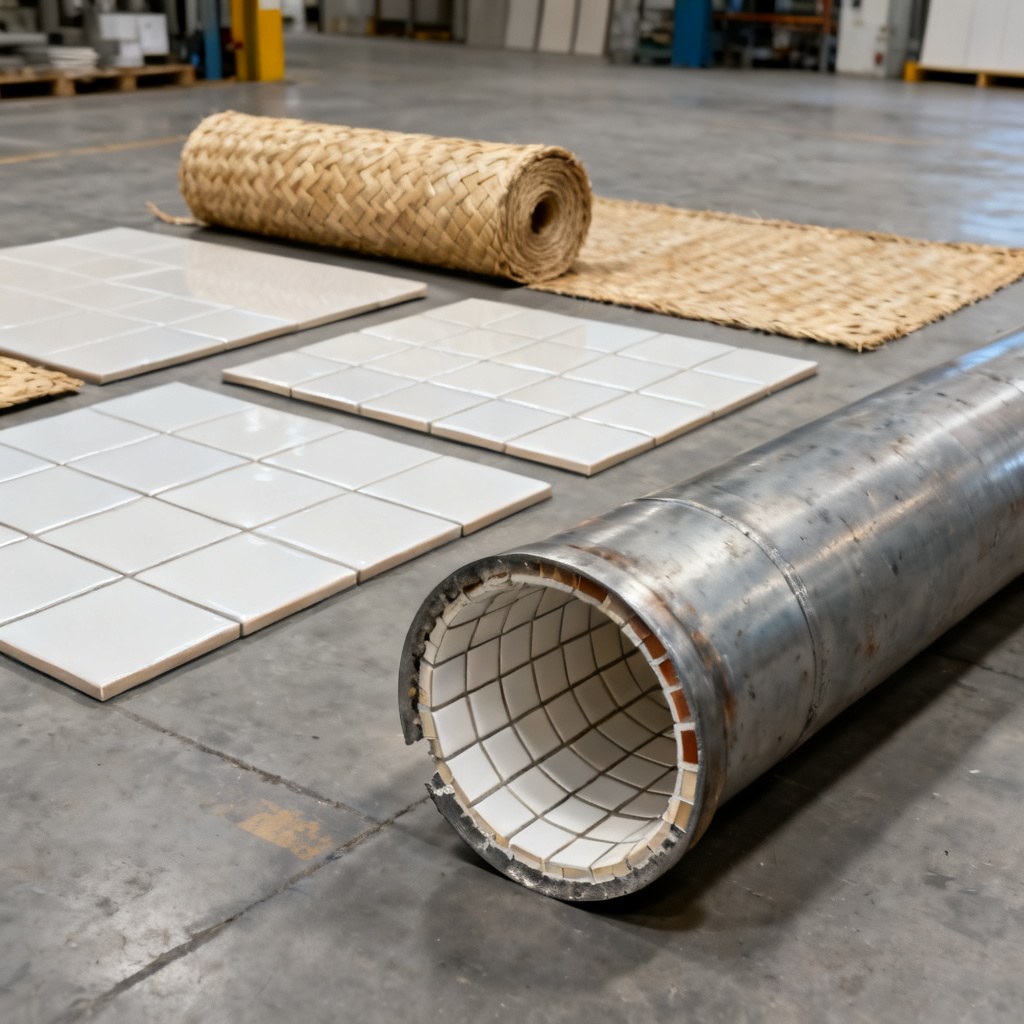
Same Duty, Different Construction
Ceramic-lined pipe exists in several constructions, and an engineer who buys the wrong one learns the difference the first time a transition zone cracks or a bend wears through its bond line. Construction decides how a liner handles impact, temperature, bending, and joining — and it moves price per metre by more than the ceramic grade does.
The Main Constructions
| Construction | How It Is Built | Strengths |
|---|---|---|
| Adhesive-bonded tile | Alumina tiles bonded to the pipe wall with high-strength epoxy | Thin wall, smooth bore, economical |
| Pin-mounted tile | Tiles anchored by welded studs, gaps grouted | Tolerant of moderate temperature and washdown; tiles can be replaced individually |
| Woven ceramic composite | Ceramic-yarn weave set in a cementitious or resin matrix | Bends with the pipe, absorbs impact, spools easily |
| Nitride-bonded ceramic | Reaction-bonded carbide/ceramic structures in heavy-duty sections | Extreme combination of toughness and wear resistance |
Sintered Alumina Tile Liners
The industry default, and for good reason: 92–95% alumina tiles deliver excellent abrasion resistance at reasonable cost. Bonded tile gives the smoothest bore and thinnest wall — useful where pressure-drop matters. Pin-mounted tile survives thermal cycling better than adhesive (which softens above roughly 100–150°C depending on system), and damaged individual tiles can sometimes be replaced on site. The weakness is impact: a large lump in the flow can chip a tile and initiate a wash-in behind it. Mitigation is to pin-and-grout at impact bends, or to use larger-radius elbows.
Woven Ceramic Composite
Woven ceramic composite behaves more like fabric than stone. The weave carries alumina, zirconia, or carbide yarn through a matrix that holds its shape, and the result handles impact without cracking, flexes along with the pipe, and tolerates cold bends and field repairs better than tile. Where direct large-particle impact or vibration is severe, woven liners often outlive their tile equivalents. The compromise: a somewhat coarser inner surface and, in some systems, slightly quicker wear in fine abrasive slurries than dense tile.
Choosing Between Them
- Fine abrasives, clear slurry: adhesive or pin-mounted sintered tile — the cheapest cost per metre-year.
- Large lumps, high impact: woven composite or pin-mounted tile with robust grout.
- Elevated temperature: pin-mounted tile with refractory grout; standard adhesives fail early.
- Bends, transitions, flexing lines: woven composite adapts; tile needs careful segments.
- Pneumatic conveying (dry): wear mechanisms differ — low-angle impingement rules — consult a wear specialist; a woven system often shines here.
Misuse That Kills Liners Early
Most liner failures trace to installation rather than manufacture: gasket faces not torqued evenly and slurry tracing along behind the liner, liner steps at joints that accelerate wear downstream, unsupported spans that vibrate tiles loose, and pipes used at temperatures above the bond specification. All are avoidable by matching the construction to the duty and holding the installation rules — the reason liner selection is an application conversation, not just a catalogue choice.
Match the Liner to the Duty
Hold-Tech supplies ceramic-lined pipe systems across tile and woven composite constructions and helps customers map duty conditions — particle size, concentration, velocity, temperature, impact history — to the right liner form, joint design, and spool strategy. Send your line data to operator@hold-tech.cn or call +86-186-60386138 and the recommendation will come back with the wear logic attached.