
The Wear Problem
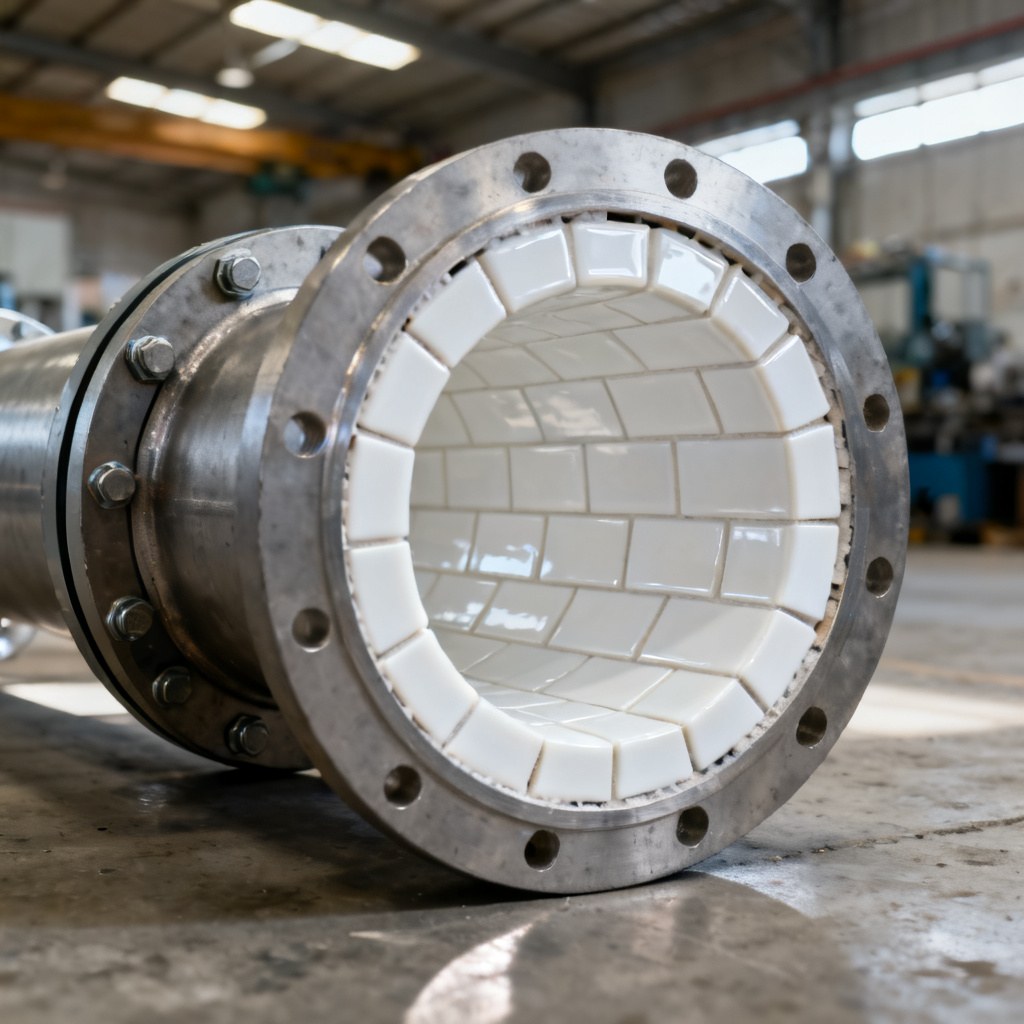
Pipelines that carry abrasive material — mining tailings, coal ash, sand, mineral concentrates, cement clinker — wear out the way pumps do. Carbon steel pipe sees wear measured in millimetres per month at high-velocity elbows, and over a plant's life the cost of replacement pipe and the downtime to change it dwarfs the original purchase. Ceramic-lined pipe is the standard answer: a steel shell carries the pressure, a ceramic lining takes the wear.
How a Ceramic Liner Works
The concept is simple. Extremely hard ceramic — typically 92–99% alumina, sometimes silicon carbide — is placed inside a welded steel pipe to face the slurry. Steel provides hoop strength and flange compatibility; alumina provides a wear surface many times harder than steel. Depending on the liner form, tiles are bonded with adhesive, pinned with studs and grouted with epoxy, or woven ceramic composite is set in a matrix. The result is a pipe that lasts years in the same duty that eats bare steel in months.
Typical Liner Systems
| Liner Form | Construction | Common Uses |
|---|---|---|
| Sintered alumina tiles | Tiles bonded or pinned inside the steel shell | General abrasive duty, straight runs, elbows |
| Woven ceramic composite | Ceramic-yarn weave filled with cement/ceramic matrix | Flexing lines, transition zones, bends |
| Cast/embedded ceramic tile | Tile set in cast or cast-in wear pads | Chutes, cyclones, transitions — often paired with pipe |
The Wear Economics
Ceramic-lined pipe typically costs several times bare carbon steel pipe and lasts 10–20 times as long in equivalent duty. Against that baseline are the secondary savings: fewer plant shutdowns for pipe changes, less spooling handling, and drastically less risk from pipe replacement intrusions. A plant that swaps a bare-steel elbow every four months buys and installs perhaps 3 to 6 elbows a year; the ceramic elbow outlives the rest of the line.
Installation Rules That Keep It Working
- Support the pipe properly: a heavy lined pipe hanging in an unsupported span leaks at the joints and fatigues the tile bonds.
- Torque flange bolts in a criss-cross pattern: uneven squeeze crushes the gasket face and lets slurry find the seam. Flat-face liners need specified gaskets — usually a ceramic-compatible rubber or composite — and torque to spec.
- Keep joints butt-to-butt: a ceramic liner edge that steps inwardly creates a step and every grain of slurry grinds it. Joints must be flush, spigot-socket, or with an internal wear ring.
- Align before tightening: never pull the flanges together with the bolts; align and then bolt.
- Handle with care: tiles chip with impact and dropped spools; a chipped tile face exposes the bond line and starts wear underneath.
Design Practices That Extend Life
- Larger radius bends: the D/d (bend diameter) ratio matters — longer-radius elbows trade a little footprint for dramatically lower wear at the impact wall.
- Flow velocity discipline: wear rises faster than linear with velocity; sizing for a sensible speed is worth more than any liner upgrade.
- Wear spools at known hot spots: quick-change ceramic spools mounted at elbows extend the campaign and make replacement a cheap, planned event.
- Transition management: the worst wear often happens where a duct becomes a pipe, or where the flow turns; ceramic-lined transition pieces absorb it.
Inspection and Maintenance
Ceramic-lined pipes tell you when they are failing: tracer leaks or visible slurry in a flange joint mean the liner has worn through. The maintenance practice is to survey liners ultrasonically where geometry allows, refurbish the bond line where a small tile has lifted, and rotate bend spools to use unworn walls. It is a low-effort regime compared with changing pipelines.
Specify the Duty, Get the Liner
Liner selection depends on what the line carries, how fast, and how far. Hold-Tech supplies ceramic-lined pipe and fittings for abrasive and pneumatic conveying duty, and we review the duty conditions before the quote — wear rate, particle size, velocity, and bends — to recommend the right liner form and the spool strategy that matches your maintenance schedule. Send the line layout to operator@hold-tech.cn or call +86-186-60386138.