
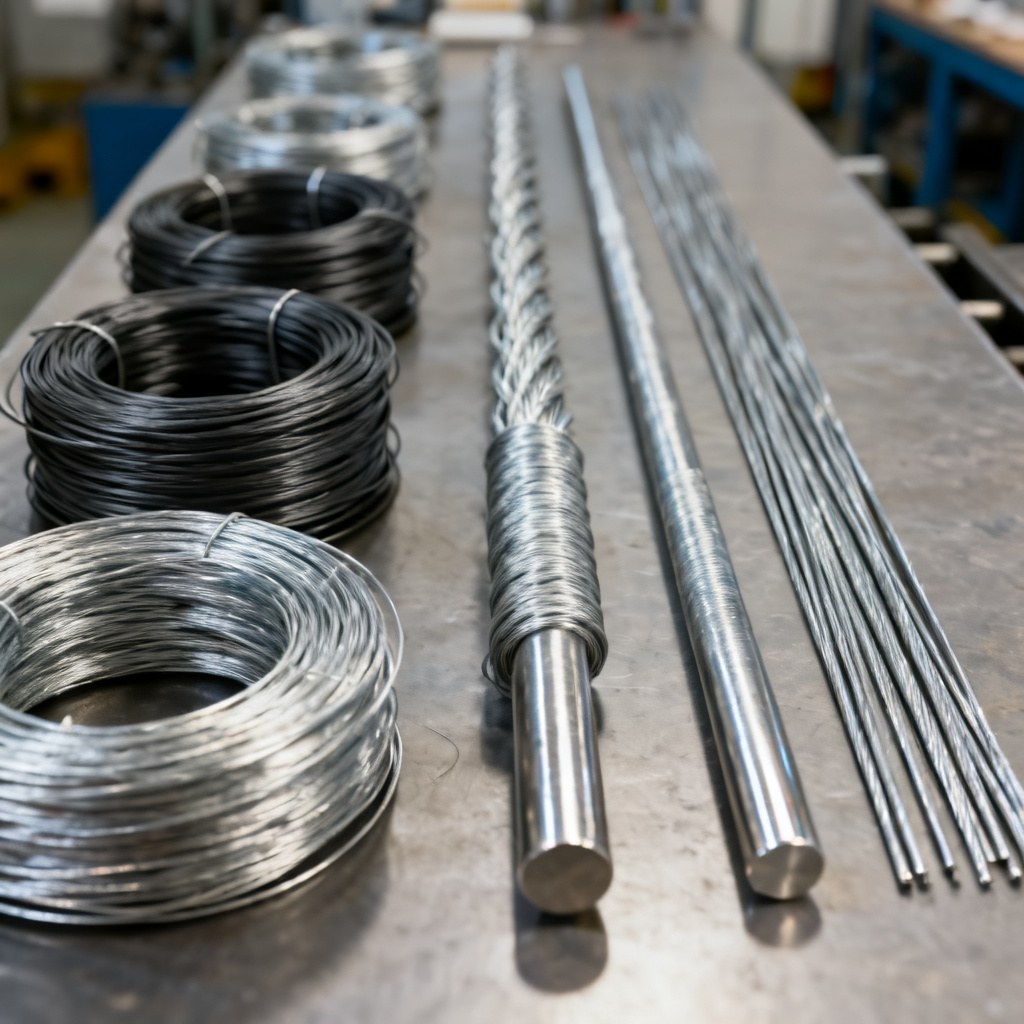
Material Choice Decides Seal Life
A weatherstrip steel core lives inside rubber, exposed to road splash, salt, heat, and millions of flex cycles. Get the material or coating wrong and the core rusts, the rubber debonds, and the seal loses clamp load long before the vehicle is out of warranty. So the material question is really a corrosion-and-fatigue question.
Low-Carbon vs High-Carbon (Spring) Steel
- Low-carbon steel (roughly 0.06–0.25% C, e.g. grades in the Q195/Q235 or SWRM family) is ductile and easy to form into zigzag or U profiles. It is the default when clamp load requirements are moderate.
- Medium and high-carbon steel (0.3–0.8% C, SWRH / spring grades) is drawn, patented, and tempered to a spring condition. It stores more elastic energy, so it holds clamp load with less material — useful for thin-wall seals and tight flange grips.
Higher carbon means higher strength but lower ductility, so tight bend radii and sharp profiling must be checked against the elongation limit before you commit a grade.
Coatings: The Real Corrosion Barrier
| Coating | Corrosion | Rubber Bonding | Typical Use |
|---|---|---|---|
| Bare / oiled | Poor | Poor | Dry, protected interiors only |
| Electro-galvanized | Good | Fair | General exterior seals |
| Hot-dip galvanized | Very good | Fair | Harsh / coastal environments |
| Brass / copper-plated | Good | Excellent | Where rubber-to-metal bond is critical |
| Zinc-phosphate | Fair | Good | Bonding primer under rubber |
| Stainless (302/304) | Excellent | Good | Premium, high-salt service |
Two rules of thumb: galvanizing protects the wire, while brass or copper plating is chosen to help the rubber vulcanize and bond to the core. On demanding seals engineers often combine them — a corrosion base coat plus a bonding top coat.
When Stainless Is Worth It
Stainless cores resist salt and acid splash without a sacrificial coating, which is valuable for coastal markets, roof and underbody seals, and premium vehicles. The trade-offs are higher cost and different forming behavior, so stainless is usually reserved for the seals that justify it rather than applied across a whole program.
Temper, Tensile, and Elongation Targets
- Temper: annealed-soft for aggressive forming; spring temper for clamp load and fatigue life.
- Tensile strength: commonly 500–1200 MPa for low-carbon cores and higher for spring-temper grades.
- Elongation: enough to survive the profiling bends without cracking the coating.
- Coating mass and adhesion: specified in g/m² and verified by bend and tape tests.
Corrosion Testing Before You Approve
Do not rely on a datasheet. Ask for neutral salt-spray results on the finished, formed, coated core, plus a bend test to confirm the coating does not flake at the profile bends. For automotive programs these results feed the PPAP and the OEM material specification.
Getting the Material Right the First Time
Hold-Tech supplies seal strip steel cores in carbon, spring-temper, galvanized, brass-plated, and stainless conditions, drawn and coated to your specification. Tell us the environment, the required clamp load, and the forming radius, and we will recommend the grade and coating that meets life targets at the lowest cost. Contact operator@hold-tech.cn or +86-186-60386138.