Ceramic Is a Family, Not a Material
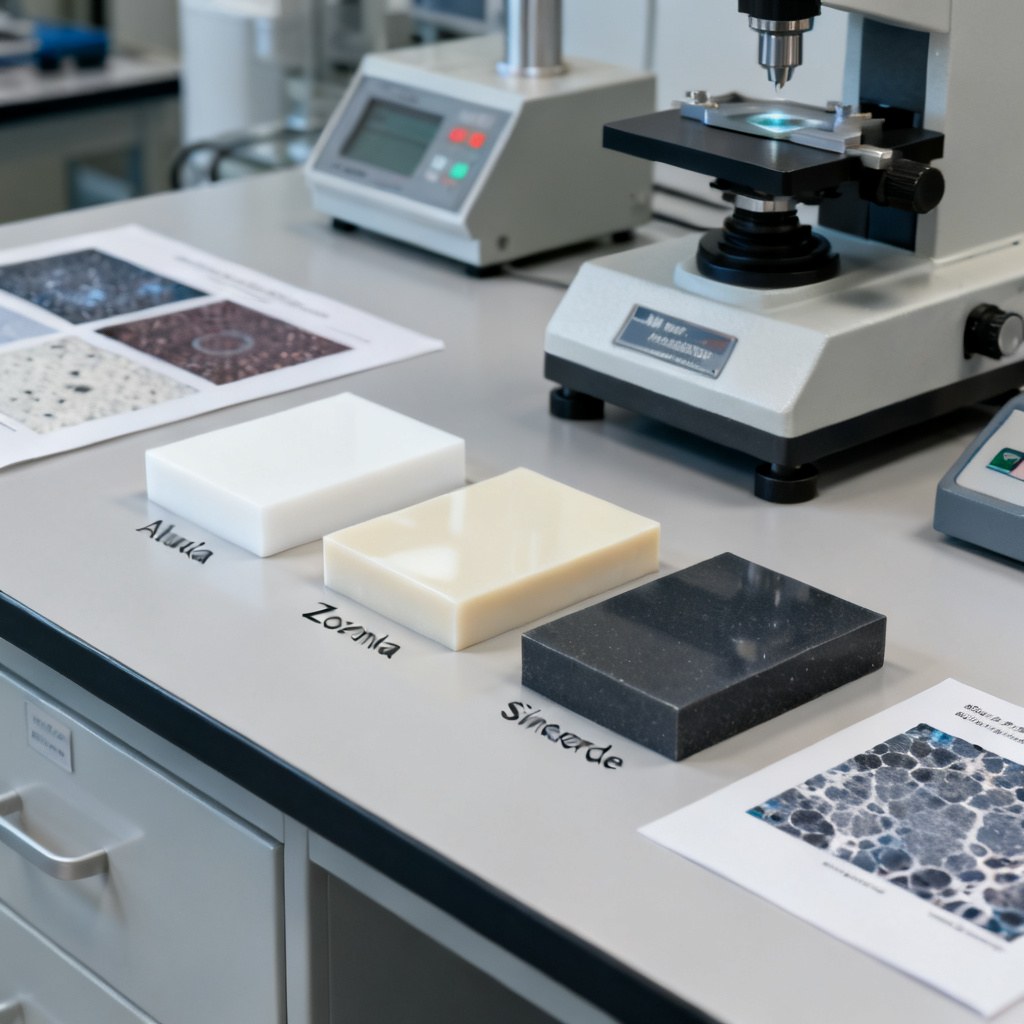
When a drawing says “ceramic”, the part is only half specified. Alumina, zirconia, silicon carbide, and silicon nitride behave so differently that the wrong grade fails where the right one lasts for years. Selection is a duty-condition question first and a cost question second.
Property Snapshot
| Property | Alumina (99.5%) | Zirconia (Y-TZP) | Silicon Carbide | Silicon Nitride |
|---|---|---|---|---|
| Hardness | ~15 GPa | ~12 GPa | ~25 GPa | ~15 GPa |
| Fracture toughness | Low–moderate | High (for a ceramic) | Moderate | High |
| Wear resistance | Very good | Good | Excellent | Very good |
| Thermal conductivity | ~30 W/m·K | ~2–3 W/m·K | ~120 W/m·K | ~20–30 W/m·K |
| Electrical resistivity | Excellent insulator | Insulator; becomes conductive at high temp | Wide bandgap semiconductor | Insulator |
| Max service temp | ~1,600°C | ~1,000°C | ~1,650°C | ~1,200°C |
| Relative cost | Low | Moderate | High | High |
Alumina: The Default Answer
Alumina is the workhorse. It is inexpensive, dimensionally stable, electrically insulating, wear resistant to its hardness, and available in pressed, milled, and 3D-printed forms. Its limitation is toughness: alumina is brittle, and in point-load or impact conditions it can crack catastrophically rather than deflect. Use it for bushings, wear pads, insulators, guide rails, and general wear surfaces — wherever loads are compressive and understood.
Zirconia: When Loads Get Ugly
Zirconia ceramics (typically yttria-stabilized) use a stress-induced phase transformation that absorbs energy at crack tips. The practical result is the toughest of the common engineering ceramics, which is why it dominates knife edges, cutting guides, forming tools, dental components, and rolling-contact bearings. It carries that toughness with two caveats: lower maximum temperature, and a slow strength-degrading transformation in humid environments (low-temperature degradation) that grade selection and densification quality manage.
Silicon Carbide: Hot and Abrasive Duties
SiC is the specialist. Extreme hardness makes it nearly unbeatable in sliding against abrasive media, and its thermal conductivity spreads heat that would build and crack a denser insulator. It suits pump seal faces, kiln furniture, burner nozzles, and slurry-facing wear components. Its drawbacks are price and difficulty: SiC is hard to grind and generally reaction-bonded or sintered rather than pressed in simple shapes.
Silicon Nitride: Thermal Shock and Speed
Silicon nitride combines high toughness with good thermal-shock resistance and low thermal expansion, which is why it races in hybrid bearings, turbine rotors, and cutting-tool inserts. Cost is the barrier, but where parts must survive rapid temperature swings at high rotational speed, it is often the only viable ceramic.
Selection by Duty
- Insulation plus wear: alumina.
- Impact, ball-contact, forming loads: zirconia.
- Extreme abrasion with heat to carry away: silicon carbide.
- Thermal shock and rotating speed: silicon nitride.
Cost per Service-Year, Not per Part
Engineering ceramics fail more often from grade selection errors than from material defects — zirconia where alumina's wear was needed, alumina where zirconia's toughness was needed. Compare options on service life in your actual conditions, not unit price. Hold-Tech builds the material choice into the part design: we review application conditions first, then the geometry, then the process. Send your ceramic component requirements to operator@hold-tech.cn or call +86-186-60386138 and we will recommend a grade with the reasoning attached.