
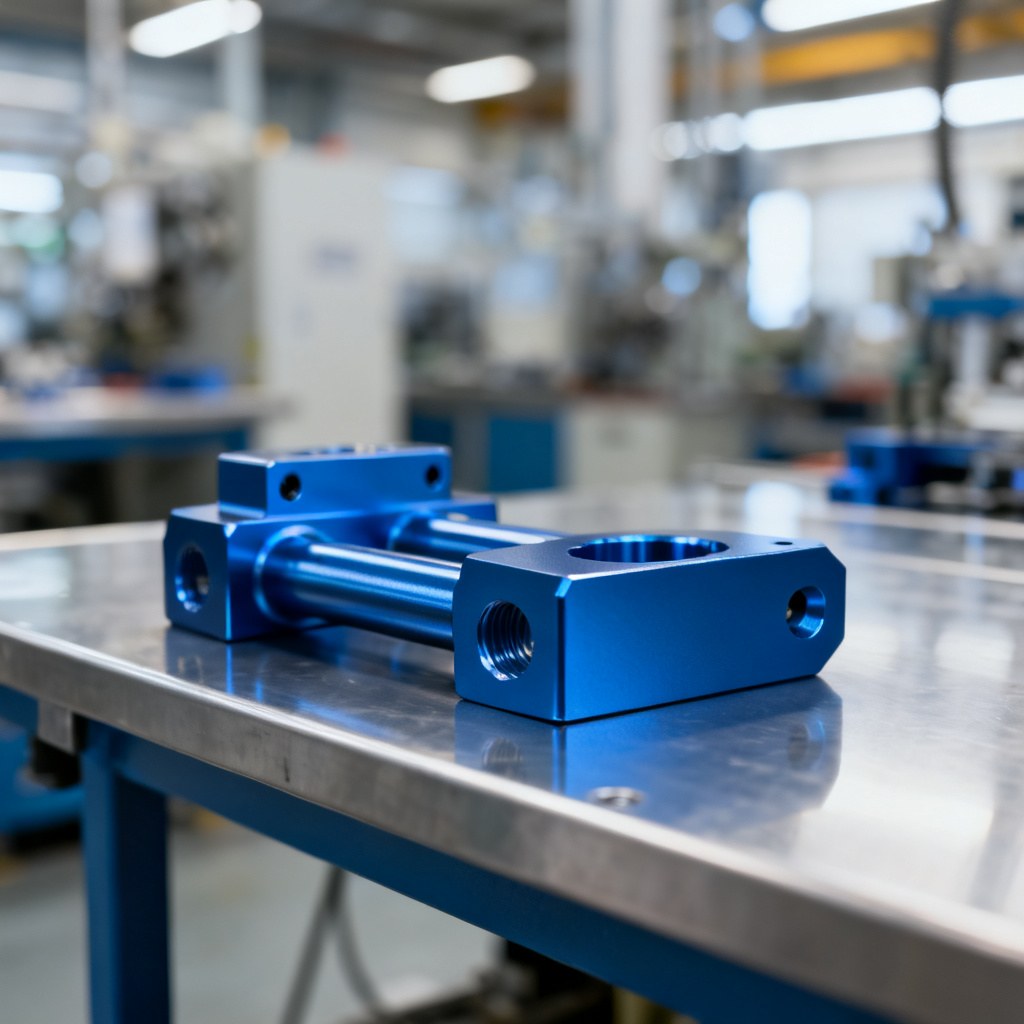
Why Anodize at All
Anodizing turns the natural oxide layer on aluminum into a thick, hard, protective coating. Compared to paint or powder coat, the anodize layer is bonded to the substrate rather than sitting on top of it, so it will not chip or peel under normal handling. It improves corrosion resistance, adds surface hardness, and — with dye — gives parts a durable color.
For machined aluminum parts, anodizing is often the default finish because it is thin, uniform, and does not add significant dimension. That dimension change is exactly why you need to specify the type and thickness carefully.
Type II: The Everyday Choice
Sulfuric acid anodizing, Type II, produces a decorative and protective coating typically 5 to 25 µm thick. It accepts dyes well, which is why you see black, red, blue, and gold machined parts everywhere.
- Typical thickness: 5–25 µm
- Growth: roughly half the coating thickness grows into the material and half out, so a 20 µm coating changes dimensions about 10 µm per surface
- Hardness: 200–400 HV, enough for cosmetic and mild wear service
- Color: nearly any dye color; natural (clear) anodize is the most economical
Type II is right for enclosures, covers, brackets, trim, and any part that needs corrosion protection without heavy load-bearing contact.
Type III: Hard Coat for Wear
Hard anodizing (Type III) uses higher voltage and lower bath temperature to create a much denser coating, typically 25 to 100 µm thick.
- Typical thickness: 25–100 µm
- Hardness: 300–600 HV, substantially more scratch and wear resistant
- Color: limited — hard coat natural is a gray/bronze; dyed hard coat is usually black only
- Dimension change: significant — the coating grows on both sides of the surface, so threaded holes and press-fit bores should be machined oversize beforehand
Type III suits pistons, slides, hydraulic components, and any surface that slides or wears against another part. The added fatigue concern: hard coat can slightly reduce fatigue life on parts under cyclic loading, worth noting for aerospace.
What to Put on Your Drawing
Ambiguous notes generate rework. Here is a minimal but clear specification:
- Type: explicit "Type II" or "Type III" (or MIL-A-8625 class number)
- Thickness: give a range, e.g. "anodize 12–20 µm"
- Color: "clear", "black", or RAL/ANSI number
- Masking: list any surfaces that must stay uncoated, e.g. "mask threaded holes & sealing faces"
- Reference standard: MIL-A-8625 or ISO 7599 for acceptance test methods
Common Pitfalls
- Assuming machined threads still fit after hard coat — leave thread allowance or mask them.
- Forgetting dye color shifts between batches — tighten color acceptance or use "natural" where color is cosmetic only.
- Designing tight fits without accounting for coating growth — on close-tolerance bores, contact your anodizer about dimensions before the coating.
- Anodizing cast aluminum — porosity and alloying elements produce uneven, sometimes cosmetic casts; specify machined material or a sealer for castings.
Specify Once, Anodize Right Every Time
The best anodize callout is one your shop can execute without asking twice. If you are unsure whether your material grade and part geometry are compatible with the finish you want, send the drawing to the Hold-Tech team. We finish machined parts across Type II, Type III, and dye-matched colors, and we review callouts like this as part of every quote.
Email operator@hold-tech.cn with your print or model and we will confirm the anodize spec with your application in mind.