
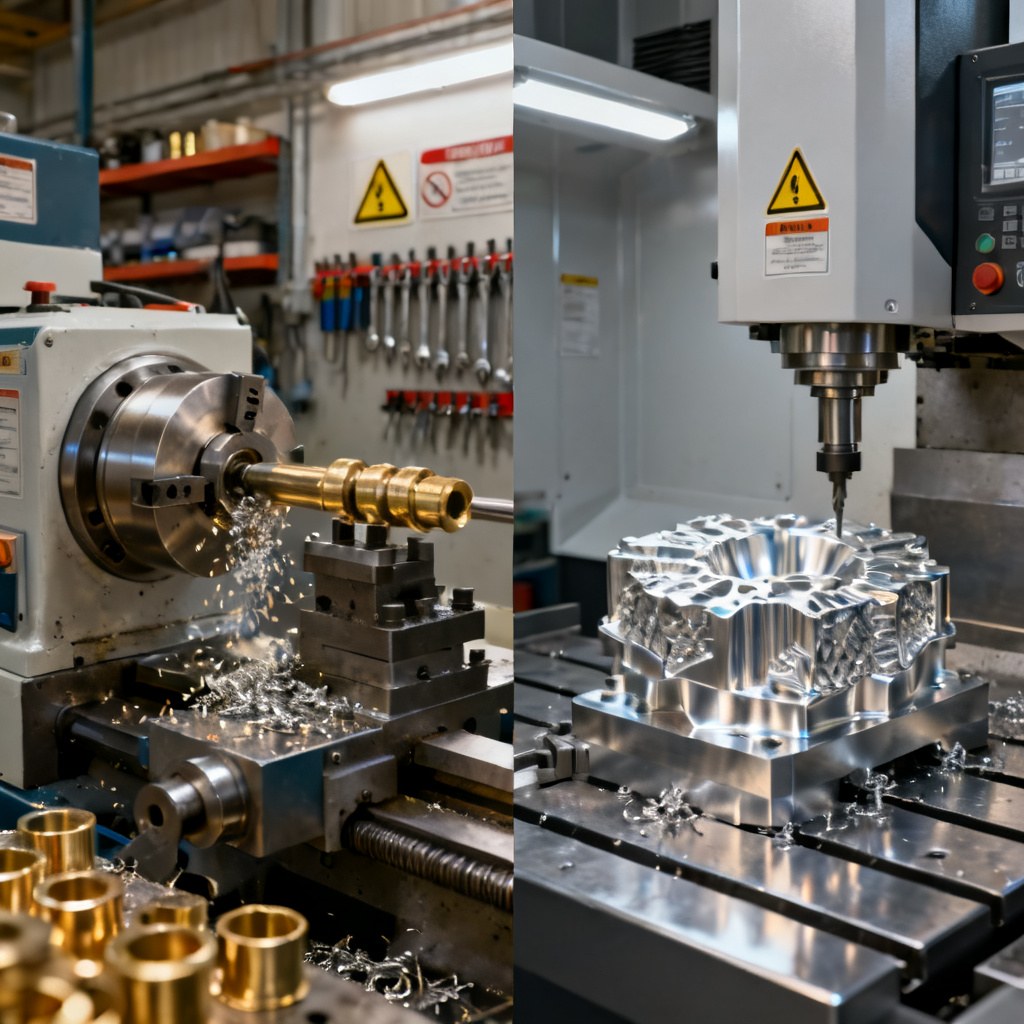
Two Good Ways to Turn a Part
Most small rotational parts can be made on either a cam automatic lathe or a CNC lathe. Engineers default to the process they know, but choosing the other one can shift a quoted price by half. The right answer depends on three numbers: annual quantity, part complexity, and how often the part changes. Hold those clearly in view, and the process selects itself.
Side by Side
| Factor | Cam Automatic Lathe | CNC Lathe |
|---|---|---|
| Setup | Cam profiling and tool setup; takes hours, pays off over long runs | Programming and offsets; takes minutes per new program |
| Cycle time (small part) | Often faster — mechanical sequencing with no interpreter dwell | Slightly slower for simple parts, with command interpolation overhead |
| Ability to change the part | Poor — cams are re-cut or replaced | Excellent — a new program and offsets |
| Secondary features | Requires separate mill-drill operations | Live tooling and Y-axis can cross-drill, mill, tap |
| Labor per machine | Low — unattended bar feeding, one operator per bank | Low, but first-article setup and probing use more attention |
| Typical break-even | Wins from roughly tens of thousands of pieces per year | Wins below that, or with geometry changes across batches |
What the Cam Lathe Likes
The cam lathe's advantage compounds with quantity. Cams are shaped once and last a long time; the machine then produces parts at a rate and cost that a CNC lathe cannot match — provided the part is small, simple, axisymmetric, and made of free-machining material. If your parts order book has one drawing locked for two years and 300,000 pieces, the cam route will price out lower at the end of a fair quote.
What CNC Likes
The CNC lathe is the safer route for the majority of business parts. It is indifferent to design changes: a revised drawing is a program revision, not a cam workshop. It handles cross-holes, flats, hexes, angled features, and eccentric contours with live tooling or a Y-axis, finishing parts that a cam lathe would have to hand off. And it never sits idle while tooling is made — the first parts can come off the machine the day the program is proven.
Hidden Factors That Tip the Decision
- Design maturity: if the drawing is still moving, CNC is right; a cam investment behind an unstable drawing is money at risk.
- Material: hard-to-machine alloys and tight-tolerance materials behave more predictably under CNC control than under fixed cam timing.
- Precision drift: a cam machine's tolerances degrade as tooling wears — and wear on a cam lathe shows up as slow dimension drift, not alarm messages; fixed-interval tool changes and first-article checks restore compliance.
- Finish and secondary operations: parts that leave the machine half-finished add cost at the next process; weigh total route cost, not just lathe cost.
- Floor flexibility: CNC lathes shuffle between jobs; cam lathes dedicate themselves. Match manufacturing strategy to machine type.
The Quantity Curve
In practice there is a break-even point on the quantity axis. Below it, CNC wins on low setup risk and changeover speed. Above it, the cam lathe's piece price dominates, even at a more expensive setup. If a part sits near that line, request quotes both ways from a supplier that offers both processes — the arithmetic from a shop's own floor data is worth far more than any general rule of thumb.
Get Both Quotes
Hold-Tech runs both CNC turning and high-volume automatic lathe production, and we quote both routes for parts near the break-even. Send the drawing, the material, and your annual volume; we will return the complete route cost — including secondary operations — so the choice is clear. Write to operator@hold-tech.cn or call +86-186-60386138.