
The Question Is Not “Can” but “When”
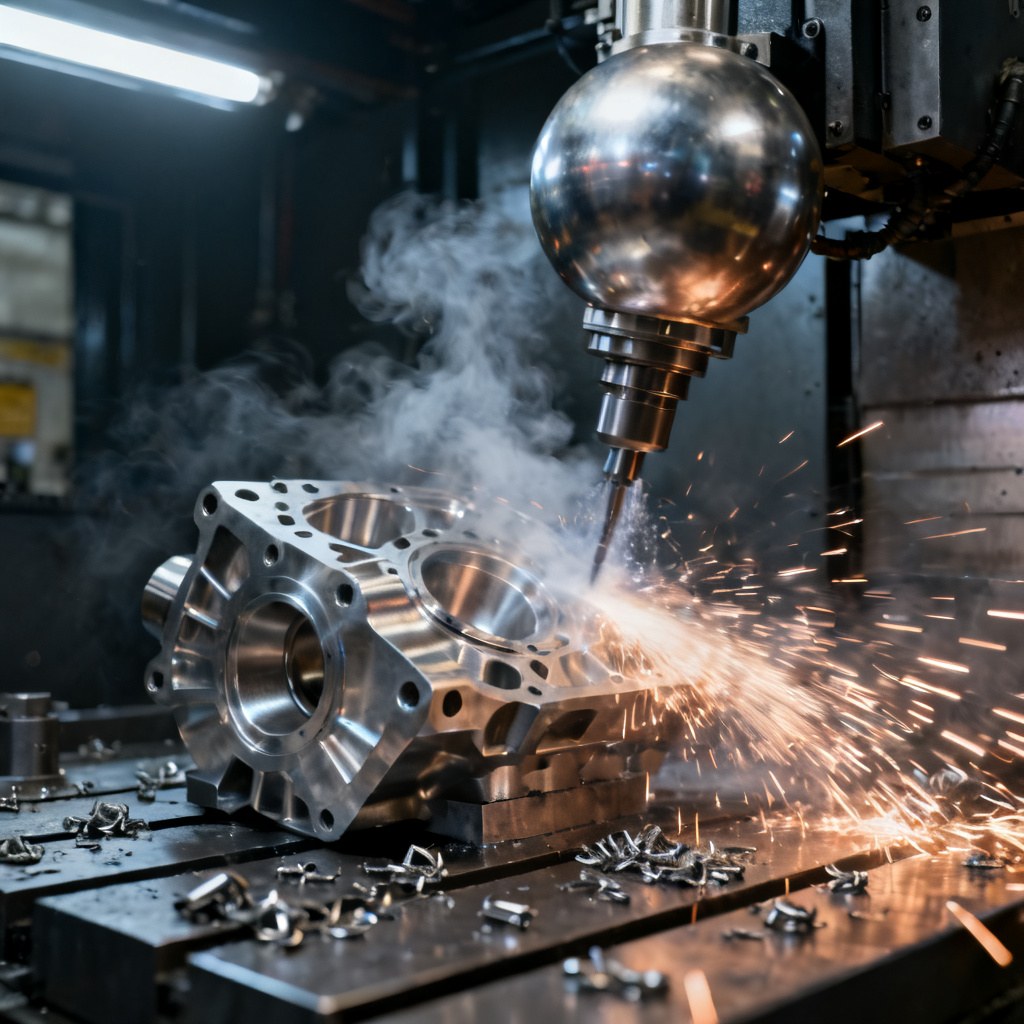
Five-axis machines are common now, but the decision of when to use them is still widely misunderstood. Five-axis is not simply a better version of three-axis — it is a different process with its own strengths, costs, and failure modes. Parts belong on five-axis when the geometry demands fewer setups than three-axis can offer, or when the part's function is worth the value of machining five sides in one clamping.
Three-Axis, 3+2, and Full Simultaneous
| Process | What Happens | Best For |
|---|---|---|
| 3-axis | Tool moves in X/Y/Z; part re-clamped for every face | Prismatic parts, flat faces, simple pockets |
| 3+2 (positional 5) | Head and table tilt to fixed angles, then 3-axis motion cuts | Angular features, fixture-accessible faces, faster than refixturing |
| Full simultaneous 5-axis | All five axes move together; tool approaches continuously | Curved surfaces, impellers, blade rows, contoured features |
Most parts written “5-axis” in industry actually use 3+2 for access, with simultaneous used only where the shape demands it. The economics of each are different: positional five-axis removes setups, while simultaneous five-axis reaches geometry that is otherwise impossible.
Where the Value Comes From
- One clamping, all sides: error does not accumulate between setups. Datum features cut in one session share exactly the same origin, which is what holds tight perpendicularity and hole-to-face relationships.
- Fewer fixtures: each fixture has build time, load/unload time, setup, and re-qualification cost. Removing two setups on a 3-hour part is real money.
- Taller tool reach: short tools at steep angles chatter less and cut more accurately than long tools plunging parallel to a tall wall.
- Undercuts and complex forms: curved surfaces and blends that force three-axis parts into multiple fixtures come off the five-axis in one go.
- Consistency: once proven, a five-axis program makes every part the same way, without operator-dependent refixturing choices.
The Cost Side of the Ledger
Five-axis machine time typically costs more per hour than three-axis, and the programming skill is a bigger investment. Simultaneous five-axis code demands verified kinematics, collision checks, and post processors tuned to the machine. Poor five-axis programs crash; that risk is why CAM verification, simulation, and a careful first-article strategy are not optional. The parts that justify it are the ones where the value above — setup elimination or impossible geometry — clearly outweighs the rate premium.
When Five-Axis Does Not Pay
- Simple prismatic blocks — three-axis with an op10/op20 split is faster and cheaper.
- Prototyping one-offs where the programming overhead exceeds the part value.
- Parts requiring large material removal — roughing is most economical on larger machines and simpler kinetics.
- Extremely tight tolerances on features best finished on grinding or honing equipment.
Decide by Cost, Not by Prestige
A useful way to frame the choice: quote the part both ways where the geometry is borderline. Compare total cost per good part including fixtures, cycle time, scrap from setup error, and lead time risk. If five-axis halves the number of operations even at a higher hourly rate, the answer writes itself. If it closes four extra setups but adds two hours of programming per batch of five, it may not.
Bring Hold-Tech the Hard Geometry
Hold-Tech plans machining routes by part value, not by machine label: solid CAM simulation, toolpath verification, and collision checking before the first chip. We run prismatic three-axis work where it fits and full five-axis where the geometry justifies it — and we say honestly which we recommend, with the cost logic attached. Send the model and the quantities to operator@hold-tech.cn or call +86-186-60386138 and we will plan the shortest path to a good part.