
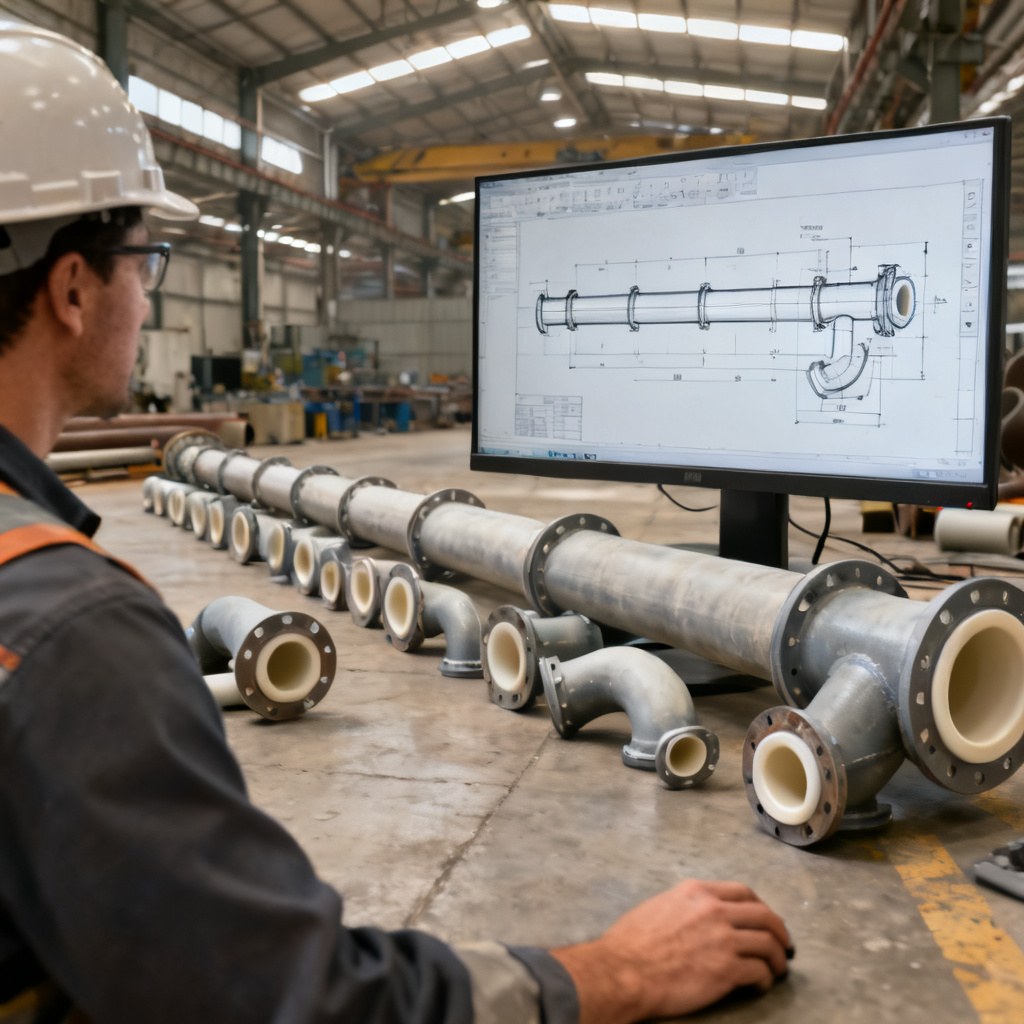
The Liner Is the System
A plant can buy a flawless ceramic liner and lose it in a year because of where the line bends, how the joints are made, or which elbow comes first. Wear in abrasive service is not evenly distributed — it concentrates at predictable places, and the design discipline is to spend your money where the wear actually is.
Where Wear Concentrates
| Hot Spot | Why It Wears | Standard Fix |
|---|---|---|
| Elbow outsides | Particle stream migrates outward and impacts | Longer-radius bend, thicker liner, or ceramic-wrapped spool |
| Downstream of elbows | Particles stay pressed on the outer wall for several diameters | Extended liner through 4–6 D past the bend |
| Transitions & reducers | Flow direction changes after compression or expansion | Ceramic/wear transitions, staged angle changes |
| Valves and diverter blades | Direct particle contact against a moving member | Wear-resistant trims, ceramic-faced blades, sacrificial sleeves |
| Joints between flanges | Steppes or gaps catch and grind slurry | Flush-butt, spigot, or internal ring joints |
Routing: Bend Radius and Sequence
Two routing decisions do most of the work:
- Bend radius: sharp short-radius elbows concentrate impact onto a small patch; long-radius elbows spread the hit and drop local wear rates dramatically. Where footprint allows, a longer radius and a matching ceramic-wrapped elbow is the cheapest wear engineering available.
- Bend spacing: back-to-back elbows whip the stream into a secondary path and hammer the following section — spacing bends where possible, and lining the wall the stream will actually contact.
Join Design
Every joint is a potential step in the bore. A step of one millimetre in the wall is a trap that a thousand particles will hit per second, and the grinder effect starts there. Preferred detail options, in rough order of preference:
- Flush ceramic-to-ceramic butt joints with an internal wear ring cut to bore.
- Spigot-socket joints where the liner spigot enters the next section's socket on a bond-free slip fit.
- Backed wear rings on the tail section where precision butt joints are impractical.
On the outside, flange faces must stay square so that the gasket compresses evenly; gasket material should be rated to the temperature and whatever the line carries. Never pull a joint together with bolts — align first, then tighten in stages across the pattern.
Velocity, Concentration, and Grade Fit
A lining's expected life scales roughly with the inverse of velocity to a power (often cited in the range of 2–3 for slurry erosion) — so a modestly oversized line that runs slower is often a better investment than the fastest thin-wall solution. Pair that with the right construction: adhesive-bonded tile for smooth fine slurries, pin-mounted or woven systems where impact and temperature rise, and nitride-bonded or carbide inserts at the fiercest locations.
Spooling Strategy
Smart systems treat the worst sections as replaceable, sacrificial elements:
- Wear spools at elbows, merges, and immediately downstream of bends — standard lengths that drop in quickly.
- Rotatable bends where the pipe can be quarter-turned in the field during scheduled shutdowns, quadrupling elbow life for the price of a turn.
- Transition spools at chute or duct-to-pipe interfaces.
This philosophy turns liner life from a gamble into a schedule: components change during planned stops instead of failing mid-campaign.
Support, Alignment, and Commissioning
Lined pipe is heavy and unforgiving of span sag; supports must be sized for the lined weight, alignment fixed before the gaskets touch, and commissioning checks should include a visual bore survey at joints before slurry flows. A short commissioning checklist — squareness, bolt torque, liner step, alignment, support coverage — prevents ninety percent of the early failures that get blamed on ceramic.
Let the Design Be Reviewed
Hold-Tech supplies ceramic-lined pipe systems and reviews routes, bends, transitions, and joining details before spools are fabricated. Send the line layout, the duty data, and the maintenance schedule to operator@hold-tech.cn or call +86-186-60386138 — we will bring back a lining and spooling plan that puts wear money where wear actually happens.