
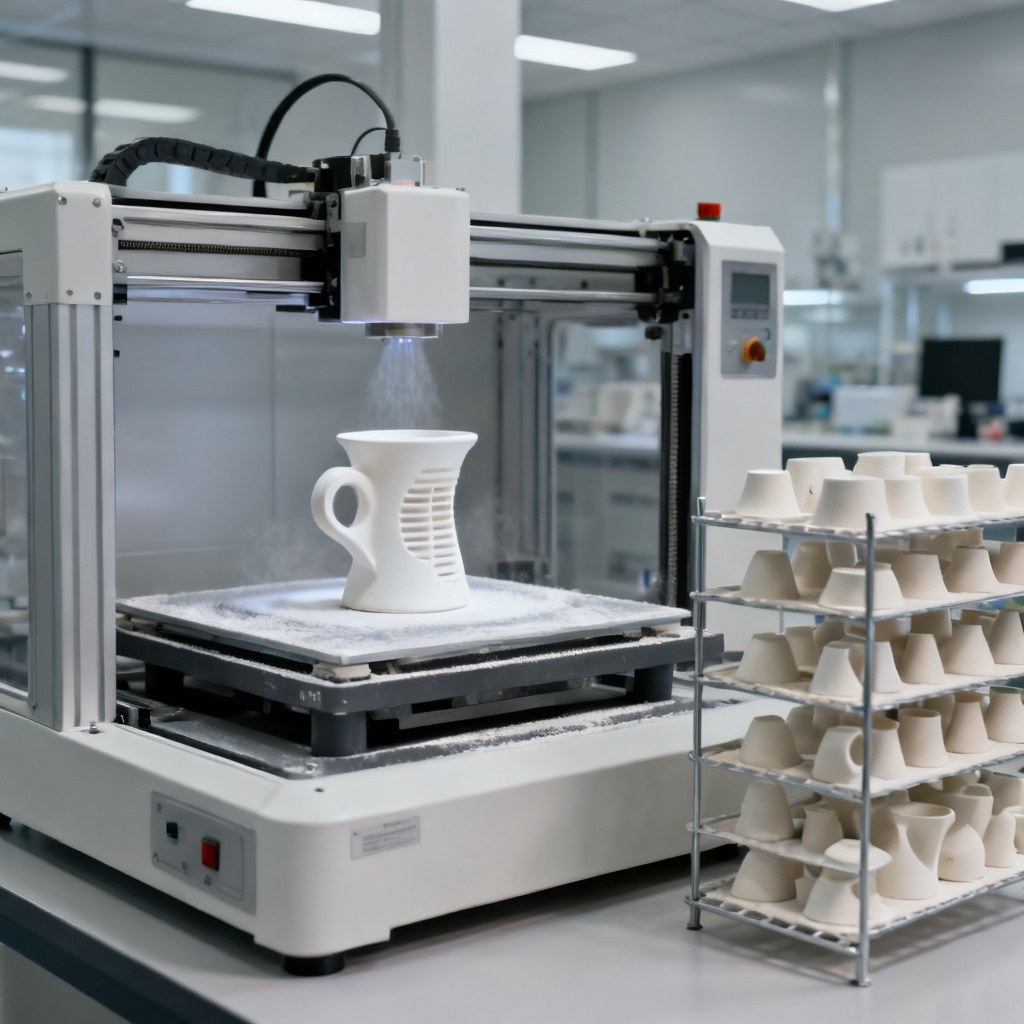
Tooling-Free Ceramics
Metal tooling is still the way to make ceramic parts in the thousands. But for low volumes, prototypes, and geometries that tooling cannot reach — internal channels, lattice structures, one-off fixtures — ceramic 3D printing has become the practical method. A file goes in, and a functional ceramic part comes out, with the shape complexity that pressing and casting simply cannot deliver.
How Ceramic 3D Printing Works
Most production ceramic printing today uses vat photopolymerization. Ceramic powder is dispersed into a light-curing resin at a high solids loading — often 60–80% powder by weight — to create a printable slurry. A DLP projector or laser cures one thin layer of resin, a build platform steps down, and the process repeats until a “green part” exists that looks like ceramic but is mostly binder. Other routes include:
- Material extrusion: clay-like ceramic paste extruded through a nozzle — slower but accessibly inexpensive for coarse parts.
- Binder jetting: a printhead deposits binder onto ceramic powder bed — excellent for sand-casting-adjacent shapes, with lower resolution.
- DMLS/SLM of ceramics: still emerging; powder bed melted or sintered with specialist parameters.
Debinding and Sintering: Where the Part Is Really Made
The green part is a scaffold of powder held in polymer. It must be converted into a pure ceramic in two thermal steps:
- Debinding — the binder is burned out slowly, in a controlled ramp, so the part does not blister or crack. This can take many hours for dense sections.
- Sintering — at temperature (1,400–1,700°C for most engineering ceramics), particles fuse and the part shrinks by roughly 15–20% linearly. Final density approaches theoretical, and strength and wear properties appear.
Those two steps are why ceramic printing is not a same-hour process. Even with overnight schedules, a finished part takes days, not minutes — so it is a tooling-free route, not a fast-turn machining substitute.
Tolerances, Finish, and Post-Processing
| Stage | Typical Capability |
|---|---|
| As-printed (green) | ±0.1 mm feature resolution; layer lines visible |
| After sintering | ±0.1–0.2 mm overall; shrinkage corrected in CAD |
| After grinding/polishing | ±0.01–0.05 mm on machined features |
| Surface finish | Ra 1–4 µm as-fired; sub-Ra 0.1 when ground |
Because sintered ceramics are hard and brittle, they are ground or lapped rather than turned and milled: diamond tooling removes material slowly, so the conventional wisdom is to print near-net, then grind only the features that need the precision. That is where a shop that understands both additive and precision finishing matters — the print orientation and allowances must be designed for the finishing pass that follows.
What Ceramic Printing Delivers
- Complex internal channels: conformal cooling, labyrinth flow paths, and venting structures that pressed tooling cannot form.
- Tooling-free prototypes: a part in alumina or zirconia in days, without waiting for an injection tool or an isostatic press cycle.
- Low-volume production: batches from one to a few hundred justify printing when injection tooling does not.
- Grade flexibility: print-and-fire shops can switch between alumina, zirconia, and other formulations without new tooling.
Know the Limits
Ceramic printing cannot do everything. Parts larger than a few hundred millimetres challenge build volume and furnace time; dense solid parts print slowly and shrink through their section; extremely thin walls can warp in debinding; and the finished part remains a ceramic — hard and wear resistant, but unforgiving of point loads and thermal shock if the grade is wrong. Every one of these is a design conversation to have before pressing print.
Specify the Grade, Not Just the Shape
Function follows material: thermal conductivity, dielectric strength, toughness, and wear rate all differ between alumina, zirconia, silicon nitride, and silicon carbide. Decide the grade with the duty in mind, then design the print orientation and grind allowances around it. Hold-Tech reviews ceramic part drawings for print-and-process suitability, and quotes the near-net-to-finished route together, so you know the real delivered cost. Send your model and the application to operator@hold-tech.cn or call +86-186-60386138.