
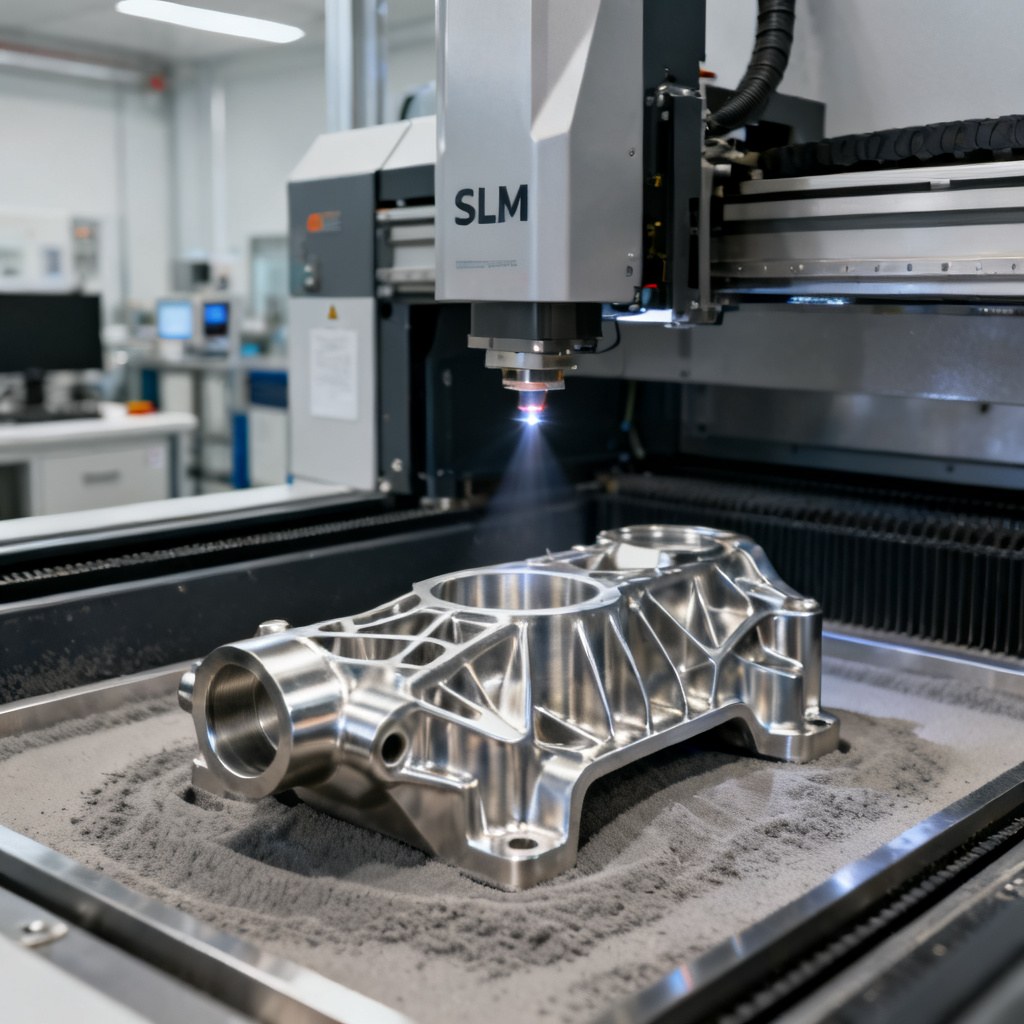
Metal Additive Has Moved Past Prototypes
Laser powder bed fusion (DMLS/SLM), electron beam melting, and directed energy deposition have crossed from novelty into qualified production processes — in aerospace, medical, and motorsport. But metal 3D printing is not a universal replacement for machining. It is a process with specific strengths, and knowing them is how you decide when it pays.
What Metal 3D Printing Is Great At
- Geometric freedom: internal cooling channels, lattice structures, complex manifolds, and organic shapes that no end mill can reach.
- Weight reduction: topology-optimized brackets can carry the same load at a fraction of milled weight — critical for aerospace and racing.
- Consolidation: dozens of machined and welded parts merge into one printed build, cutting assembly time, leaks, and supply chain complexity.
- Material efficiency: unused powder is recycled, so buy-to-fly ratios change dramatically versus hogging from billet.
- Low to medium series with geometry value: once the geometry justifies it, cost per part can beat legacy processes.
The Trade-offs You Must Design For
- Surface finish: as-printed finishes run Ra 6–12 µm; functional surfaces need machining or post-processing.
- Residual stress: rapid melting and cooling leave internal stress that can distort parts; stress-relieving heat treatment is standard.
- Build orientation matters: strength is best in the plane perpendicular to build direction; unsupported overhangs below ~45° need supports.
- Anisotropy and defects: porosity and lack-of-fusion defects are controlled by process qualification and inspected with CT or destructive testing.
- Cost of powder and machine time: printed parts are billed in build time, so dense solid parts are usually cheaper machined.
Machining Before and After the Build
Metal printed parts are rarely shipped as-printed. The common hybrid workflow is:
- Design for the process — orientation, support strategy, datum management.
- Print the near-net part with a small machining allowance on critical features.
- Heat treat to relieve stress and achieve target properties.
- Machine critical surfaces, bores, threads, and sealing faces to final tolerance.
- Inspect — CMM for geometry, CT or eddy current for internal soundness, metallurgical evaluation for the acceptance spec.
This is where a shop that does both additive and precision machining adds the most value: the print and the machining strategy can be planned together instead of sent to two suppliers who each guess at the other's constraints.
Cost and Lead-Time Reality Check
| Scenario | Machining from Billet | Metal 3D Printing |
|---|---|---|
| Simple bracket, 100 pcs | Low cost, fast | Rarely competitive |
| Topology-optimized aerospace bracket | High buy-to-fly, heavy, joins | Competitive, lighter, one piece |
| Impeller with internal cooling channels | Not machinable in one piece | Only realistic route |
| First article for complex casting | Good geometry check | Good geometry check but different properties |
Know Your Acceptance Path Upfront
For regulated industries, ask about qualification before you print: material spec, process spec, powders, build parameter sets, and testing requirements all affect feasibility and cost. A part that passes functional testing but cannot be accepted on paper still blocks your release.
Partner With a Hybrid Shop
Hold-Tech has built its capability road map around machining first and additive as a complementary process. We review parts for print-vs-machine decisions with your cost and acceptance criteria in front of us, and we machine printed parts to the tolerances the drawing demands. That means one engineering conversation, one quality system, and one set of hands on your part across the whole route.
Bring us a part that is difficult or impossible to mill. Send the model and the load case to operator@hold-tech.cn and we will recommend the most economical way to make it real.