
The Economics Decide Everything
Ceramic 3D printing is not competing with pressed-and-sintered tooling on the factory floor for the millionth seal ring. It wins in a specific window: complex geometry, low volume, and a duty where tooling cost or tooling lead time blocks the program. Inside that window there are several applications where printing is not just acceptable — it is the only sensible route.
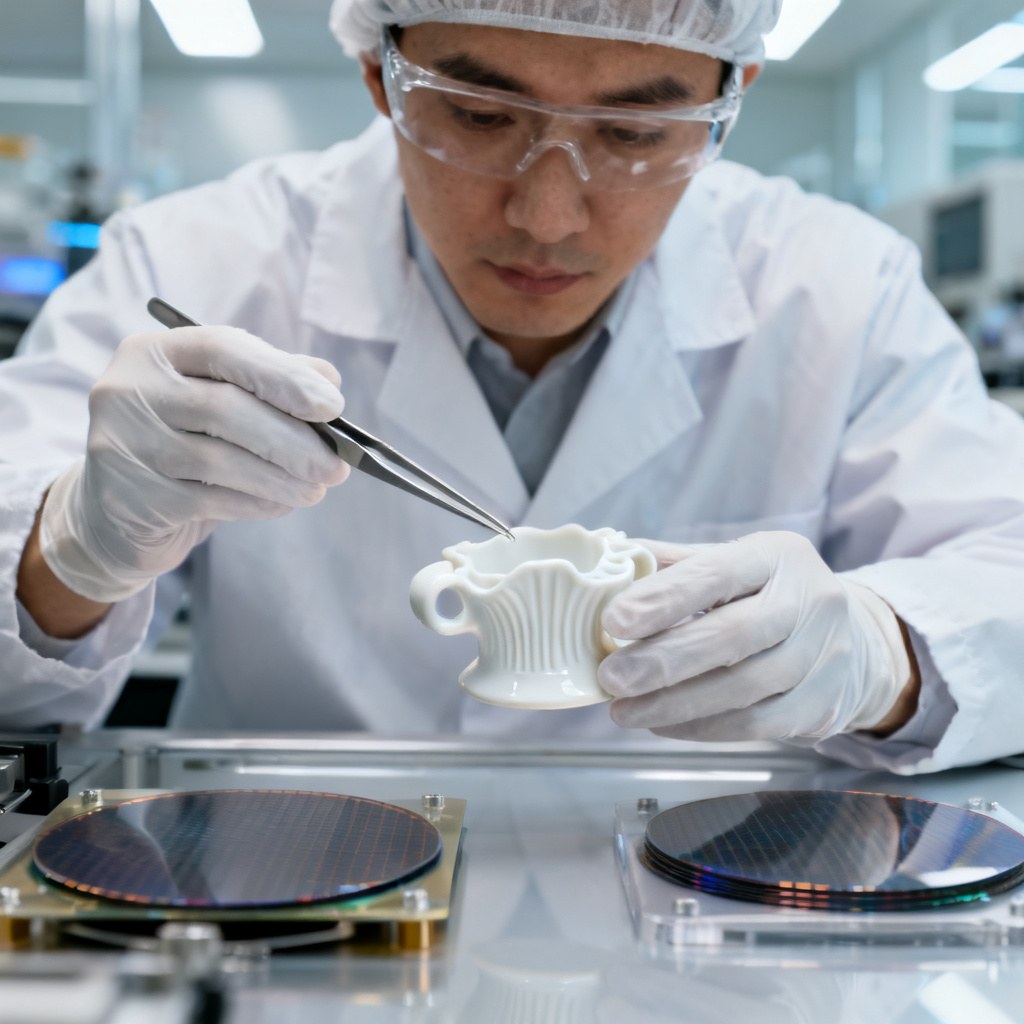
Semiconductor and Cleanroom Components
Semiconductor equipment lives on specialty ceramic parts: wafer clamps, ceramic rings for plasma processes, insulators, and precision stages that must be pure, flat, and dimensionally forgiving. These parts are usually small, high-value, and made in engineering batches. Printing wins there because:
- Tooling is prohibitive at low volume: a machined-from-blank ring or a pressed prototype is expensive; printing converts a file into the part in days.
- Redesign iteration is cheap: equipment makers change chamber geometry as recipes evolve, and a printed part updates with the file.
- Grades match the process: high-purity alumina and aluminum nitride meet purity and outgassing requirements where metals do not.
Custom Jigs, Fixtures, and Thermocouple Protection
Factories maintain an endless supply of one-off needs: a fixture to hold a part during inspection, a probe guide, a ceramic insulator for a furnace thermocouple, a wear guide for a packaging line. All were historically made by grinding stock ceramic or waiting for tailored tooling. Printing replaces the wait with a design file and an overnight build — and if the fixture needs revision, the revision costs nothing but the print.
Medical and Dental
The medical world accepts additive because volumes are small and shapes are patient-specific:
- Dental: surgical guides, provisional restorations, and biocompatible zirconia frameworks — a growing case-patient-by-case industry.
- Implants and cages: zirconia and hydroxyapatite structures with porous architectures that bone can grow into.
- Prototypes for validation: functional pieces for fit-testing and sterilization-cycle trials before committing to an injection tool.
High-Temperature and Corrosive Components
Rings, crucibles, and burner components that must survive aggressive environments with shapes that preclude conventional forming — internal channels, thin ribs, integral flanges — are strong printing candidates. Where a part combines extreme heat with geometry that casting cracks during drying, print-and-fire solves the geometry directly.
What Still Belongs to Tooling
Honesty requires the boundary. Simple wear bushings, seal rings, and insulators in high volume remain cheaper pressed or machined from bar. Thick-walled solid prints are slow and shrink through the section; huge parts exceed build plates and furnaces; and applications demanding tight tolerance on mating surfaces almost always need a grind pass after firing.
How to Evaluate the Candidate
- Does the geometry need features that tooling cannot form — channels, lattices, blended curves?
- Is the volume below the threshold where tooling amortizes — hundreds or fewer per year?
- Can the part live with as-fired tolerances plus grinding on critical features?
- Is the grade settled (alumina, zirconia, or something more exotic)?
- Does the schedule need a part in days, not weeks?
Five yeses mean the window has opened — and a print quote should be on your desk.
One Shop, Print to Finished Part
Hold-Tech takes ceramic components from design review through printing, sintering, and precision finishing, with inspection support to match the drawing. When your ceramic part is complex, low-volume, and urgent, bring the model to operator@hold-tech.cn or call +86-186-60386138 and we will tell you quickly whether printing is the right process.