The Importance of Material Selection
Choosing the right material for your CNC machined parts is critical to the success of your product. The material affects not only the part's performance and longevity but also its manufacturability, cost, and lead time. Making the right choice requires balancing mechanical properties, environmental factors, and budget constraints.
At Hold-Tech Precision Industrial, our engineering team regularly advises customers on material selection, helping them optimize their designs for both performance and cost-effectiveness.
Key Factors in Material Selection
Mechanical Properties
- Tensile strength: Maximum stress the material can withstand while being stretched
- Yield strength: Stress at which permanent deformation begins
- Hardness: Resistance to indentation and wear
- Elongation: Ductility and ability to deform before fracture
- Fatigue strength: Resistance to cyclic loading
Environmental Considerations
- Corrosion resistance: Critical for marine, chemical, and outdoor applications
- Temperature resistance: Important for high-temperature applications like engines and exhaust systems
- UV resistance: Relevant for outdoor exposure
- Chemical compatibility: Essential for parts exposed to specific chemicals
Manufacturability
- Machinability rating: Affects cycle time, tool wear, and surface finish
- Weldability: Important for assemblies requiring joining
- Heat treatability: Enables property enhancement after machining
Popular CNC Materials and Their Applications
Aluminum Alloys
Aluminum is the most commonly machined material due to its excellent machinability, light weight, and good strength-to-weight ratio.
| Alloy | Key Properties | Common Applications |
|---|---|---|
| 6061-T6 | Good strength, excellent machinability, weldable | Aerospace structures, automotive parts, enclosures |
| 7075-T6 | High strength, aerospace-grade | Aircraft fittings, mold tools, high-stress components |
| 5083 | Excellent corrosion resistance, marine-grade | Marine components, cryogenic applications |
| 2024-T3 | High strength-to-weight ratio | Aerospace structures, truck wheels |
Stainless Steels
Stainless steels offer excellent corrosion resistance and good mechanical properties.
| Grade | Key Properties | Common Applications |
|---|---|---|
| 304 | Good corrosion resistance, formable, weldable | Food processing, architectural, general purpose |
| 316 | Superior corrosion resistance, marine-grade | Marine, chemical processing, medical devices |
| 17-4PH | Precipitation hardening, high strength | Aerospace, nuclear, chemical processing |
| 416 | Free-machining, good corrosion resistance | Screws, nuts, bolts, fittings |
Carbon and Alloy Steels
| Grade | Key Properties | Common Applications |
|---|---|---|
| 1018 | Good machinability, case hardening | Pins, shafts, bushings |
| 1045 | Medium strength, good machinability | Gears, shafts, bolts |
| 4140 | High strength, good toughness, heat treatable | Aerospace, oil & gas, automotive |
| 4340 | Very high strength and toughness | Landing gear, axles, structural components |
Titanium Alloys
Titanium offers exceptional strength-to-weight ratio and corrosion resistance but is more challenging to machine.
| Grade | Key Properties | Common Applications |
|---|---|---|
| Grade 2 (CP) | Excellent corrosion resistance, good formability | Chemical processing, marine, medical |
| Grade 5 (Ti6Al4V) | High strength, excellent fatigue resistance | Aerospace, medical implants, racing |
| Grade 23 (ELI) | Higher purity, better ductility | Medical implants, surgical instruments |
Copper and Brass Alloys
| Alloy | Key Properties | Common Applications |
|---|---|---|
| C11000 (Electrolytic Copper) | Excellent electrical and thermal conductivity | Electrical components, heat exchangers |
| C36000 (Free-Cutting Brass) | Excellent machinability, good corrosion resistance | Valves, fittings, connectors |
| C93200 (Bearing Bronze) | Good wear resistance, self-lubricating | Bushings, bearings, wear plates |
Engineering Plastics
| Material | Key Properties | Common Applications |
|---|---|---|
| PEEK | High temperature, chemical resistant, strong | Aerospace, medical, semiconductor |
| Delrin (POM) | Low friction, good dimensional stability | Gears, bearings, connectors |
| PTFE (Teflon) | Lowest friction, chemical resistant | Seals, gaskets, bearings |
| Nylon | Tough, wear-resistant, self-lubricating | Gears, bushings, electrical insulators |
Machinability and Cost Considerations
Material machinability significantly affects production cost:
- Easy to machine: Aluminum 6061, Brass C360, Delrin - low cycle times, minimal tool wear
- Moderate: Mild steel, stainless 304, titanium Grade 2 - moderate cycle times and tool wear
- Difficult: Inconel, titanium Grade 5, hardened steels - longer cycle times, specialized tooling required
Material Selection Decision Framework
When selecting a material for your CNC machined part, consider these questions:
- What are the mechanical load requirements?
- What environmental conditions will the part face?
- Are there regulatory or industry-specific material requirements?
- What is the target cost per part?
- What quantity will be produced?
- Are there weight constraints?
- Does the part require specific surface treatments or finishes?
Expert Material Selection Support from Hold-Tech Precision Industrial
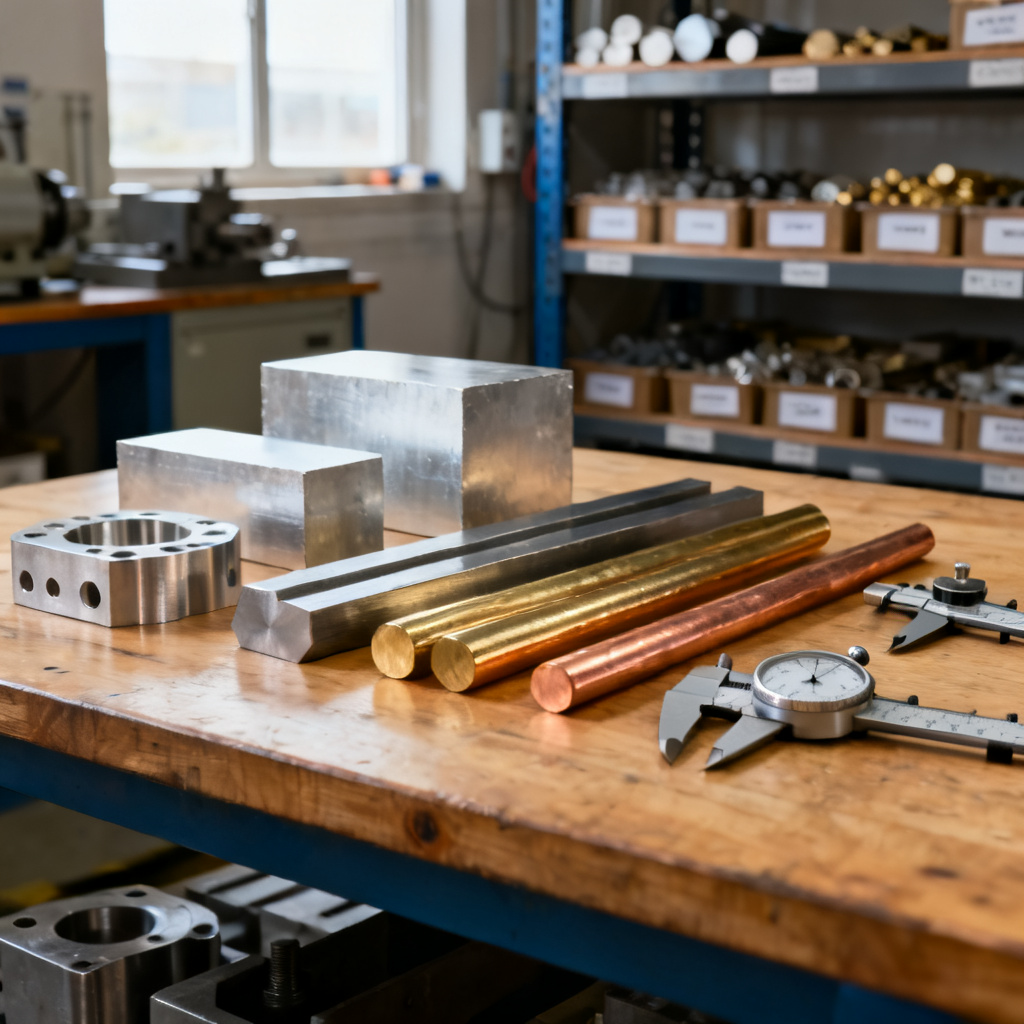
Our engineering team at Hold-Tech Precision Industrial can help you select the optimal material for your application, considering performance requirements, manufacturability, and cost. We maintain an extensive inventory of materials and can source specialized alloys upon request.
Contact our engineers: https://hold-tech.cn | [email protected] | +86-186-60386138