What is Precision Metal Stamping?
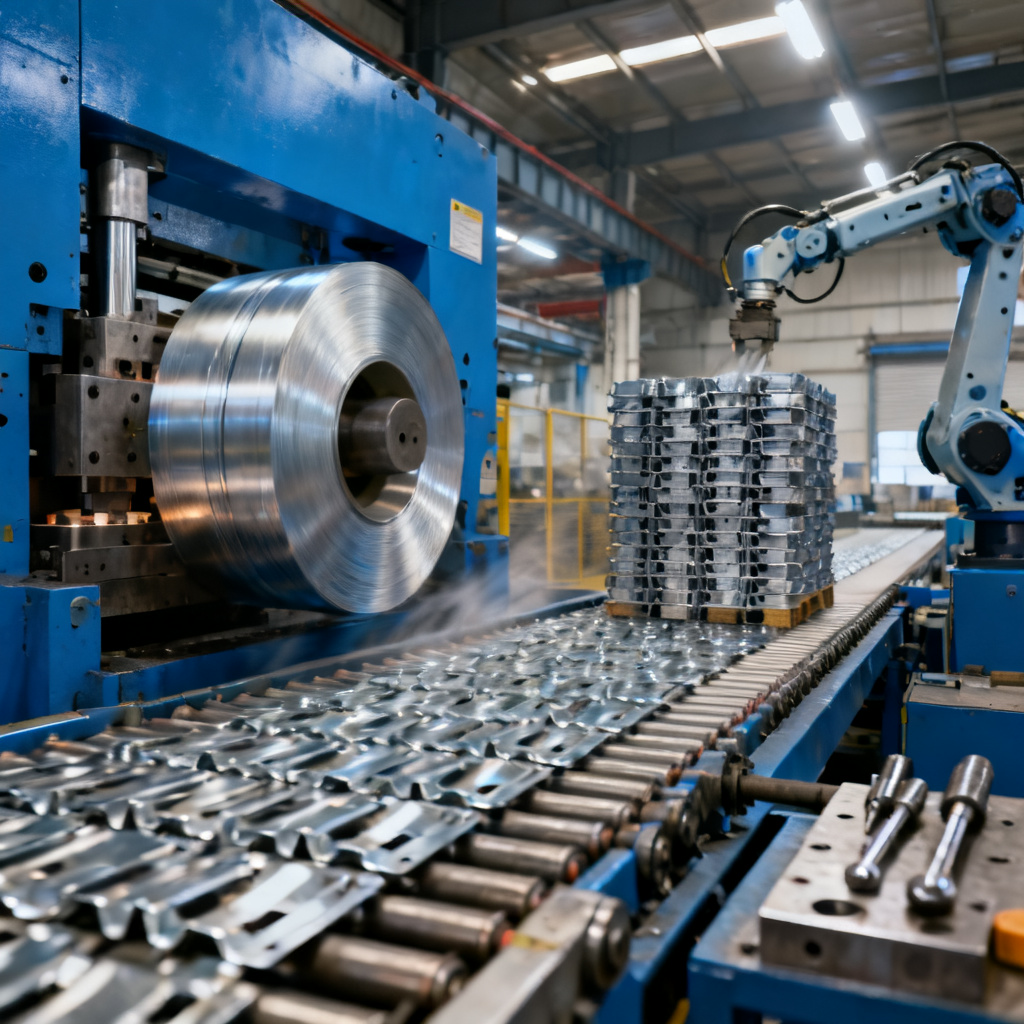
Metal stamping is a high-speed manufacturing process that transforms flat metal sheets or coils into precisely shaped parts using presses and dies. When combined with precision tooling and advanced quality control, metal stamping can produce millions of identical parts with tolerances as tight as +/- 0.05mm, making it one of the most cost-effective manufacturing methods for high-volume production.
At Hold-Tech Precision Industrial, metal stamping is a core capability that complements our CNC machining and sheet metal fabrication services, providing customers with optimal solutions for high-volume component production.
Metal Stamping Processes Compared
Progressive Die Stamping
Progressive die stamping is the most efficient method for high-volume production. A coil of metal feeds through a series of stations within a single die, with each station performing a different operation:
- Piercing: Creating holes and cutouts
- Bending: Forming angles and contours
- Blanking: Cutting the part from the strip
- Drawing: Forming cup or shell shapes
Best for: Complex parts requiring multiple operations, volumes of 100,000+ pieces
Advantages: High speed (up to 2,000 strokes/min), minimal handling, consistent quality
Transfer Stamping
Transfer stamping uses a mechanical transfer system to move parts between separate dies within a press. This method is ideal for:
- Larger parts that cannot be carried in a coil
- Parts requiring multiple deep draws or complex forming
- Components needing operations from multiple angles
Best for: Large structural parts, automotive components, appliance housings
Compound Die Stamping
Compound dies perform multiple operations (blanking and piercing) in a single stroke, offering:
- Excellent flatness and dimensional accuracy
- Lower tooling costs than progressive dies
- Ideal for simpler flat parts and washers
Four-Slide and Multi-Slide Stamping
Multi-slide presses use multiple sliding tools to form parts from multiple directions simultaneously, enabling:
- Complex wire and strip metal forming
- Intricate brackets, clips, and connectors
- Parts with features in multiple planes
Materials for Metal Stamping
Selecting the right material is critical for stamping success. Common stamped materials include:
| Material | Applications | Key Properties |
|---|---|---|
| Low Carbon Steel (SPCC, SPHD) | Brackets, enclosures, automotive parts | Excellent formability, cost-effective |
| Stainless Steel (304, 316, 430) | Medical devices, food equipment, marine | Corrosion resistance, hygienic |
| Aluminum (1100, 3003, 5052) | Electronics, heat sinks, lightweight parts | Light, corrosion-resistant, conductive |
| Copper/Brass (C110, C260) | Electrical connectors, terminals | Conductive, spring properties |
| Galvanized Steel | Outdoor enclosures, HVAC components | Corrosion protection, economical |
Tooling Design: The Foundation of Quality Stamping
Stamping die design determines part quality, production speed, and tool life. Key considerations include:
Die Clearance
The gap between punch and die must be optimized for material type and thickness:
- Too little clearance: excessive cutting force, premature tool wear
- Too much clearance: burrs, distorted edges, poor part quality
- Optimal clearance: typically 5-10% of material thickness per side
Strip Layout Design
Efficient strip layout maximizes material utilization and production speed:
- Material utilization: Target 60-80% for progressive dies
- Pilot holes: Ensure accurate strip positioning
- Carrier design: Maintain strip integrity through all stations
- Scrap cutting: Clean separation of skeleton from parts
Die Materials and Coatings
Tool steel selection affects die life and part quality:
- D2 tool steel: General purpose, good wear resistance
- Carbide inserts: Extended life for high-volume production
- TiN/TiCN coatings: Reduce friction and wear
Quality Control in Metal Stamping
Consistent quality in high-volume stamping requires systematic quality control:
First Article Inspection (FAI)
Complete dimensional verification of the first production parts from a new die setup:
- All critical dimensions measured and documented
- Material verification and hardness testing
- Surface quality and burr height inspection
In-Process Quality Monitoring
Ongoing quality checks during production:
- Statistical Process Control (SPC): Monitor critical dimensions using control charts
- Automated vision systems: Detect missing features, burrs, and surface defects
- Force monitoring: Detect die wear or material variation through press load analysis
Common Stamping Defects and Solutions
| Defect | Cause | Solution |
|---|---|---|
| Burring | Excessive die clearance, worn cutting edges | Adjust clearance, sharpen or replace inserts |
| Springback | Material elasticity, insufficient bend radius | Overbend compensation, use coining stations |
| Wrinkling | Insufficient blank holder pressure | Adjust pressure, add draw beads |
| Cracking | Excessive forming, material too hard | Anneal material, reduce draw ratio |
| Galling | Material adhesion to die surface | Apply lubricant, use coated tool steel |
Cost Optimization Strategies
Design for Stamping (DFS)
Optimizing part design for stamping reduces tooling and production costs:
- Uniform bend radii: Use the same radius throughout the part
- Avoid sharp corners: Minimum inside radius = material thickness
- Standard hole sizes: Use common punch sizes to reduce tooling
- Minimize features: Each feature adds a die station and cost
- Generous tolerances: Specify only necessary tolerances
Volume-Based Cost Savings
| Annual Volume | Recommended Process | Relative Cost per Part |
|---|---|---|
| 100 - 1,000 | Laser cutting + bending | High |
| 1,000 - 10,000 | Turret punching | Medium |
| 10,000 - 100,000 | Compound die stamping | Low |
| 100,000+ | Progressive die stamping | Lowest |
Why Partner with Hold-Tech for Metal Stamping
At Hold-Tech Precision Industrial, we offer comprehensive metal stamping services backed by decades of manufacturing expertise:
- Full-service capability: From die design and fabrication to production and assembly
- Advanced equipment: Presses from 20 to 400 tons, progressive and transfer stamping
- Material expertise: Working with steel, stainless steel, aluminum, copper, and specialty alloys
- Quality assurance: ISO 9001 certified with comprehensive inspection capabilities including CMM
- Competitive pricing: China-based manufacturing with international quality standards
- Engineering support: DFM review, strip layout optimization, and tooling design assistance
Getting Started with Your Stamping Project
Whether you need a simple bracket or a complex multi-station progressive stamped component, Hold-Tech provides end-to-end manufacturing solutions. Our engineering team can review your design, optimize it for stamping, and provide a competitive quotation within 24 hours.
Contact Hold-Tech today:
- Website: https://hold-tech.cn
- Email: [email protected]
- Phone: +86-186-60386138