
The Evolution of Boat Jack Plates
Performance boaters have relied on jack plates for decades to lift and lower outboard motors in the water. The idea is simple: raise the engine out of the water to get the right trim angle for clean, efficient running, and lower it for stable low-speed handling. But the jack plate itself has barely changed for decades — until now. The rise of inboard/outboard (IOO) and outboard boats in the 150–300+ HP class has pushed boaters and OEMs alike to rethink the entire trim system.
Why 300 HP Changes the Game
A 150-HP outboard and a 300-HP outboard are not just different in speed — they're different in weight, thrust, and the trim requirements needed to get the boat onto plane efficiently. As boat builders ship bigger engines on more platforms, the traditional manual or small electric jack plate simply can't keep up. Here's where the modern hydraulic jack plate up to 300 HP earns its place:
- Smoother trim response: hydraulic cylinders deliver precise, metered movement that a manual crank or basic electric jack can't match.
- Higher load capacity: engineered for boats carrying 300-HP outboards — often 2–3× heavier than a 150-HP setup — without structural compromise.
- Integrated controls: modern systems pair with electronic trim gauges, dashboard switches, and even closed-loop auto-trim controllers.
- Reliability under load: a hydraulic actuator under 300 HP can handle the high-impulse loads of aggressive planing and water-ski towing that stress basic electric lifts.
Jack Plate Anatomy — What to Look For
When a boat builder or aftermarket installer specifies a hydraulic jack plate for a 300-HP platform, a few features separate a good system from a premium one:
- Load rating: verify the jack plate is rated to the combined weight of engine, transom load, and dynamic water forces — not just the dry engine weight.
- Actuator stroke: at 300 HP, enough travel matters. Most boats need 10–14 inches of lift, and the hydraulic system should have clean, full-travel motion.
- Materials: marine-grade aluminum, stainless hardware, and corrosion-resistant seals are non-negotiable for salt and brackish water.
- Mounting points: the base weld or bolt pattern must match the hull without cutting into structural members.
- Hydraulic sizing: cylinder bore, hose size, and pump capacity all have to scale with 300-HP trim loads or the system will run hot and leak under load.
Hydraulic Jack Plates vs. Other Trim Systems
There are four broad families of boat trim solutions — and for 300-HP platforms, hydraulic jack plates tend to win on capability:
| System | Best for | Limitations at 300 HP |
|---|---|---|
| Manual crank | Small outboards (< 100 HP) | No remote control; hard to adjust under load |
| Electric jack plate | 100–200 HP outboards | Struggles under heavy loads; limited stroke |
| Hydraulic jack plate | 200–300+ HP outboards | Requires a hydraulic pump and reservoir |
| Power trim / tilt (engine-integrated) | Most modern outboards | Fixed to engine; can't lift the whole powertrain |
Hydraulic jack plates are the preferred system when the boat must actually raise and lower the entire outboard at 300 HP — for example, when the trim angle needs to change more than what power tilt alone can achieve, or when operating on deep-draft inland and coastal water where planing trim matters most.
The Precision-Engineering Challenge at 300 HP
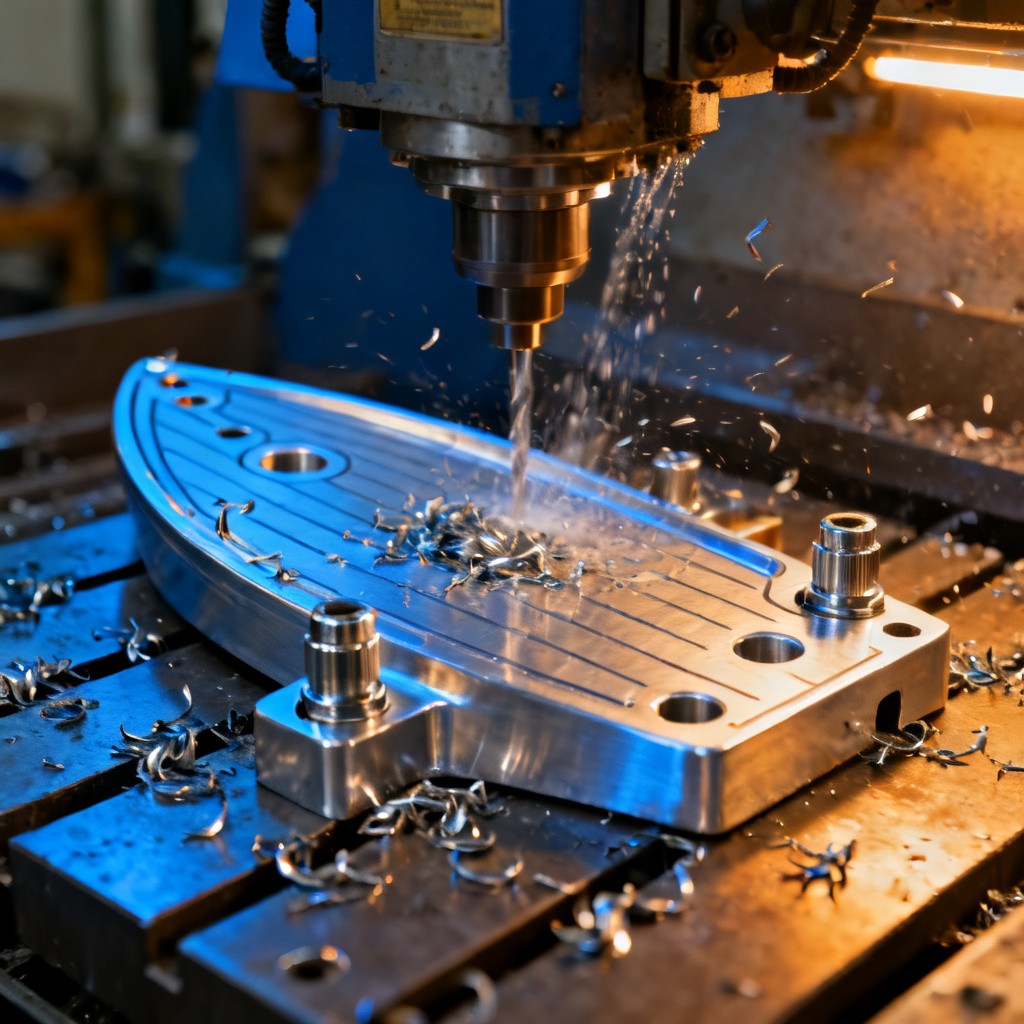
A hydraulic jack plate is a deceptively demanding part. The main plate body is typically CNC-machined from marine aluminum, then surface-finished and corrosion-protected. But the real engineering challenge is in the details:
- Load path integrity: the hydraulic cylinder mounting boss must be fatigue-machined so it can carry repeated cyclic loads without micro-cracking.
- Tight tolerances on cylinder bores: hydraulic seals require bore finishes at micro-inch level to hold pressure — typically 0.4–0.8 µm surface finish.
- Corrosion compatibility: mating parts must be designed to avoid galvanic corrosion between aluminum, stainless, and brass in salt water.
- Full traceability: for marine OEMs, every lot of 300-HP jack plates needs dimensional inspection and material certification.
Hold-Tech Precision Industrial: Jack Plates for the 300-HP Era
Hold-Tech Precision Industrial manufactures hydraulic jack plates and boat trim components rated up to 300 HP for boat builders, performance boat brands, and marine aftermarket suppliers worldwide. Our capabilities are purpose-built for exactly this kind of load-critical marine application:
- 5-axis CNC machining for complex jack plate geometries with integrated cylinder bosses, drain ports, and mounting interfaces
- CNC turning and milling for marine-grade aluminum, stainless steel, and titanium trim housings
- Precision bore finishing (0.4–0.8 µm) for hydraulic cylinder seal compatibility
- Robotic automation for high-volume production of jack plate kits and hydraulic sub-assemblies
- Full CMM inspection with dimensional reports and material traceability for every lot
- ISO 9001 quality management system with marine-application PPAP documentation
- Surface treatment — anodizing, passivation, and corrosion-resistant finishes rated for marine environments
Whether you're specifying a single prototype hydraulic jack plate or ordering production runs for a 300-HP boat series, our engineering team can take your drawings, do DFM reviews, and deliver machined parts with full inspection data. For projects with specific load ratings, we run FEA-supported design reviews on critical bosses and mounting interfaces.
Get a quote: operator@hold-tech.cn · +86-186-60386138 · hold-tech.cn