CNC Turning vs. CNC Milling: Choosing the Right Machining Process for Your Precision Parts
By the Engineering Team at Hold-Tech Precision Industrial | Published May 9, 2026

Introduction: Two Pillars of Precision Machining
When engineers and sourcing professionals need to produce high-quality custom metal parts, two manufacturing processes dominate the conversation: CNC turning and CNC milling. While both are subtractive manufacturing processes controlled by computer numerical control (CNC) systems, they differ fundamentally in how they remove material, the geometries they produce, and the applications they best serve.
Choosing between them—or understanding when to combine both—is a critical decision that affects part cost, lead time, quality, and design flexibility. This guide provides a detailed comparison of CNC turning and CNC milling, covering the mechanics, capabilities, ideal applications, and cost implications of each process.
The Fundamental Difference: Workpiece vs. Tool Movement
The core distinction between turning and milling lies in which part of the system moves during cutting:
| Property | CNC Turning | CNC Milling |
|---|---|---|
| Primary Motion | Workpiece rotates | Cutting tool rotates |
| Tool Movement | Stationary (with linear/angled feed) | Multi-axis movement (X, Y, Z, and rotational) |
| Primary Shape | Cylindrical, symmetrical about a center axis | Prismatic, complex 3D geometries |
| Typical Operations | Facing, tapering, threading, grooving, boring | Contouring, pocketing, slotting, drilling, tapping |
| Surface Finish | Excellent (Ra 0.4–1.6 µm typical) | Good to excellent (Ra 0.8–3.2 µm typical) |
| Material Waste | Moderate (chips from O.D. reduction) | Higher (removes material from billet) |
CNC Turning: The Process Explained

CNC turning, performed on a lathe or turning center, involves rotating a cylindrical workpiece at high speed while a stationary cutting tool removes material. The workpiece is securely held in a chuck or collet on the spindle, and the cutting tool moves along the X and Z axes to create the desired diameter, length, and contour.
Key Advantages of CNC Turning
- Exceptional concentricity: Since the part rotates, features are naturally concentric to the center axis, making turning ideal for shafts, bushings, and bearing housings.
- Superior surface finish: The continuous cutting action of a lathe produces a smooth, consistent surface finish with proper parameters. Tolerances of ±0.013 mm (±0.0005 in) are routinely achievable.
- High material removal rate: Turning can remove material rapidly, especially for roughing passes on large diameter stock.
- Lower cost per part for cylindrical geometries: For any part that is primarily round, turning is almost always the most economical choice.
Limitations of CNC Turning
- Non-cylindrical features require secondary operations or live tooling (turn-mill centers)
- Geometries are generally limited to rotationally symmetric parts
- Internal features (square pockets, cross holes) require additional milling operations
CNC Milling: The Process Explained
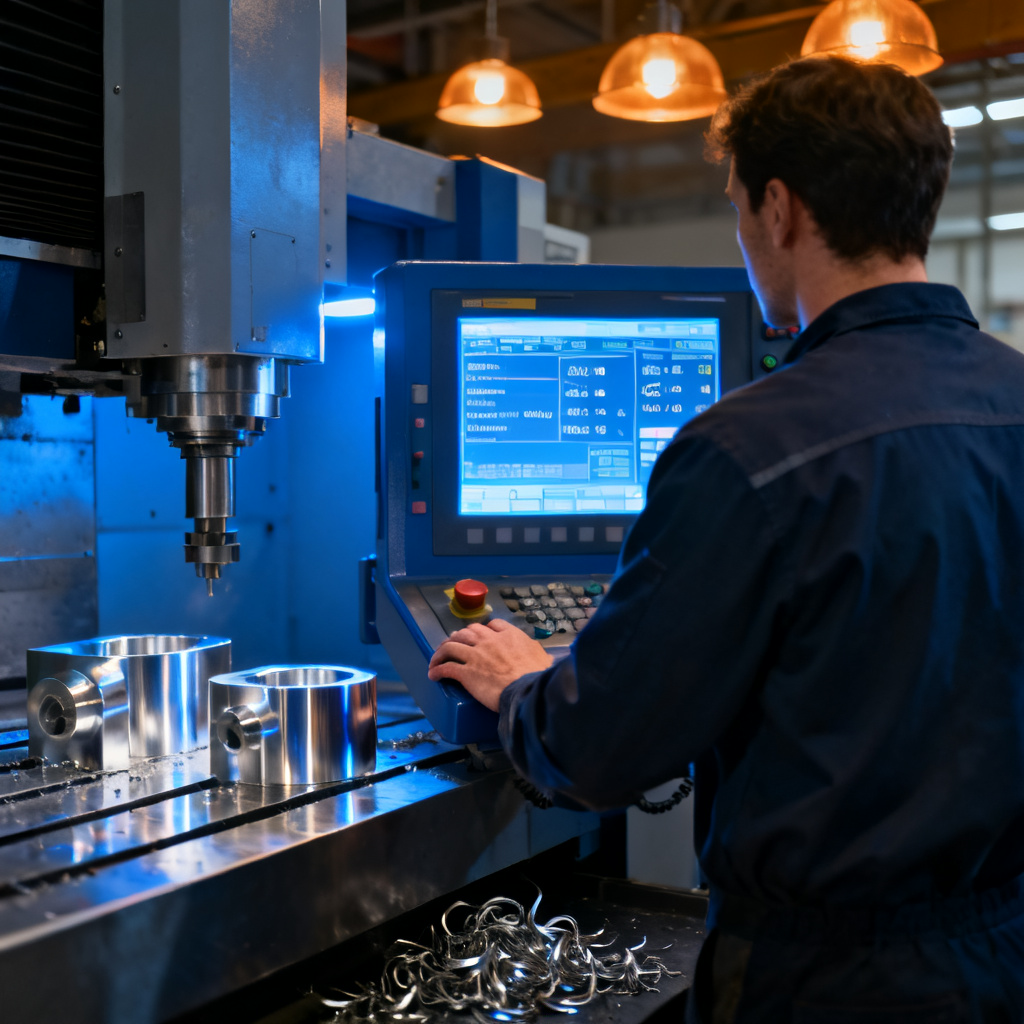
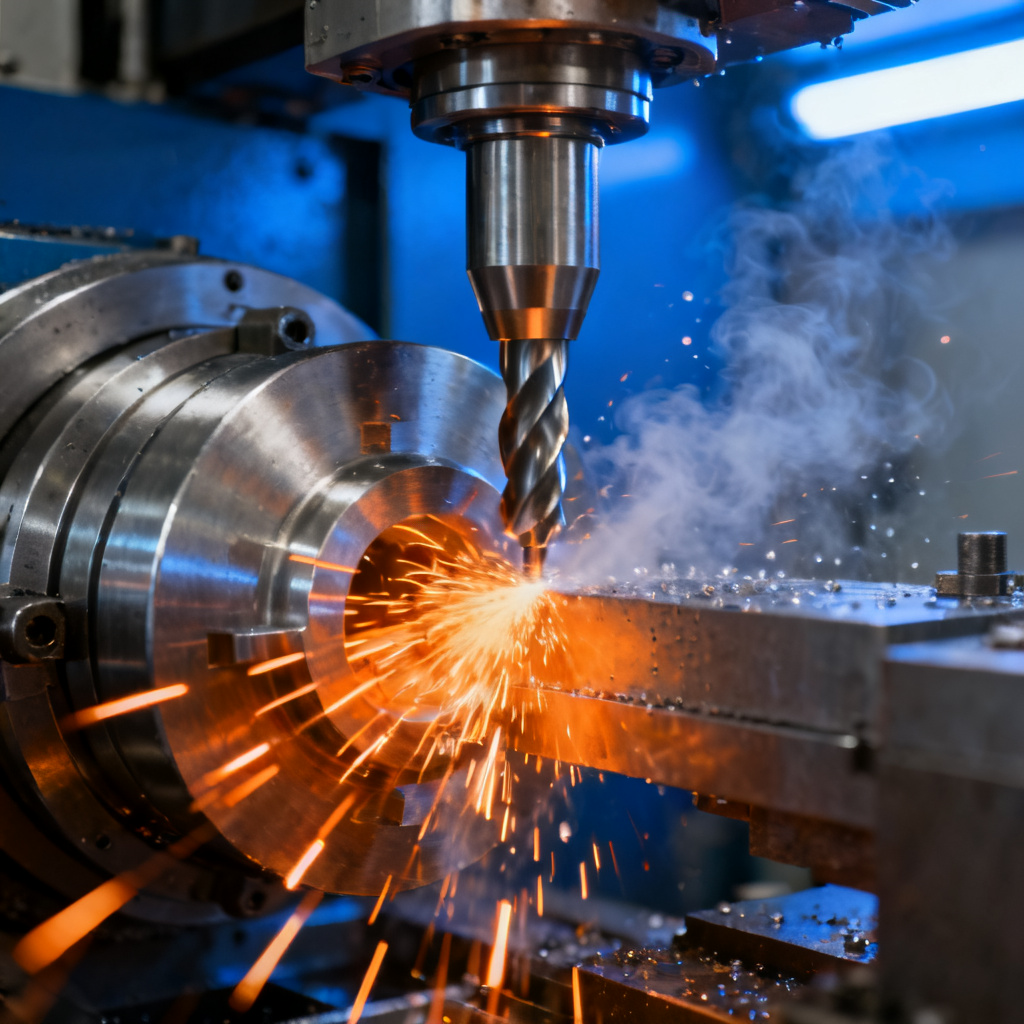
CNC milling, performed on a milling machine or machining center, uses rotating multi-point cutting tools to remove material from a stationary workpiece. The workpiece is clamped to the machine table, and the tool moves along multiple axes (typically 3, 4, or 5) to create complex geometries with precision.
Key Advantages of CNC Milling
- Geometric versatility: Milling can produce almost any 3D shape—flat surfaces, slots, pockets, contoured profiles, undercuts, and complex freeform surfaces.
- Multi-face machining: With 4- and 5-axis machines, multiple faces of a part can be machined in a single setup, reducing handling errors and lead time.
- Ideal for box-shaped and flat parts: Milling excels at producing prismatic parts like brackets, housings, plates, and frames.
- Precision hole-making: Milling centers can drill, tap, bore, and ream holes with high positional accuracy.
Limitations of CNC Milling
- Generally more expensive than turning for purely cylindrical parts
- Surface finish quality depends heavily on tool path strategy and step-over
- Thin-walled features are more challenging due to cutting forces
When to Choose Turning vs. Milling
Choose CNC Turning When:
- Your part is primarily cylindrical or rotationally symmetric (shafts, pins, rollers, bushings, rings)
- Concentricity between multiple diameters is critical
- A superior surface finish on cylindrical surfaces is required
- You are manufacturing high volumes of round parts
- The part length-to-diameter ratio is high (slender parts)
Choose CNC Milling When:
- Your part has complex 3D geometries, pockets, or contoured surfaces
- The part is primarily box-shaped, flat, or has features on multiple faces
- You need precise hole positioning with tight true-position tolerances
- The part includes features like T-slots, dovetails, or complex cavities
- You require prototyping or low-to-medium volume production of complex parts
Combining Both: Turn-Mill Centers

Modern manufacturing has blurred the line between turning and milling with the advent of turn-mill centers (also called multi-tasking machines). These machines combine the capabilities of a lathe and a machining center in a single platform, allowing both turning and milling operations to be performed without moving the workpiece between machines.
Turn-mill centers feature live tooling—rotating cutting tools mounted on the turret—that can perform milling, drilling, and tapping operations on a rotating or indexed workpiece. This capability is especially valuable for parts that have both cylindrical and prismatic features, such as hydraulic valve bodies, medical instrument components, and automotive drivetrain parts.
At Hold-Tech Precision Industrial, our manufacturing floor is equipped with advanced CNC lathes, 3-, 4-, and 5-axis machining centers, and multi-tasking turn-mill machines. This diverse capability allows our engineering team to recommend the most cost-effective process for each part—or a combination of processes—based on your specific design requirements and production volume.
For parts that truly benefit from both processes, turn-mill centers reduce the total number of setups from two or more down to one, improving accuracy by eliminating re-clamping errors and reducing lead time by up to 40% compared to traditional multi-machine workflows.
Cost Comparison: Turning vs. Milling
| Factor | Turning | Milling |
|---|---|---|
| Setup Cost | Low to Moderate | Moderate to High |
| Per-Part Cost (Cylindrical Parts) | Low | High |
| Per-Part Cost (Prismatic Parts) | N/A or Very High | Moderate |
| Tooling Cost | Low (single-point tools) | Moderate (multi-point, end mills, drills) |
| Lead Time (Simple Parts) | 1–3 days | 2–5 days |
| Lead Time (Complex Parts) | 3–7 days (with live tooling) | 3–10 days |
Material Considerations
| Material | Turning Suitability | Milling Suitability |
|---|---|---|
| Aluminum (6061, 7075) | Excellent | Excellent |
| Stainless Steel (304, 316) | Good (requires rigid setup) | Good |
| Steel (1018, 4140, 1045) | Excellent | Excellent |
| Titanium (Grade 2, 5) | Good (slower speeds) | Fair (challenging) |
| Brass / Copper | Excellent | Excellent |
| Plastics (PEEK, Nylon, Acetal) | Excellent | Good (chip evacuation critical) |
Case Study: Optimizing a Hydraulic Valve Body Production
A European hydraulics manufacturer approached Hold-Tech Precision Industrial to produce a custom valve body that included both precision cylindrical bores and complex prismatic mounting features. The original process plan specified two separate machine setups: a CNC lathe for the bore and thread features, followed by a 4-axis machining center for the mounting faces and port holes.
The Hold-Tech engineering team recommended shifting production to a turn-mill center with live tooling and Y-axis capability. This eliminated the inter-machine transfer, reduced total cycle time by 35%, and improved bore-to-face perpendicularity from ±0.05 mm to ±0.02 mm by eliminating re-clamping error.
The customer achieved a 28% reduction in per-part cost and a compressed lead time from 8 weeks to 4 weeks for the initial production run of 200 units. Quality yield improved from 94% to 99.2% due to the reduction in handling-related defects.
Conclusion: Making the Right Choice
The decision between CNC turning and CNC milling ultimately depends on your part geometry, tolerance requirements, material, and production volume. For cylindrical, rotationally symmetric parts, turning offers unmatched efficiency and surface quality. For complex, multi-feature parts with prismatic shapes, milling provides the geometric freedom required. And for parts that straddle both categories, modern turn-mill centers offer a compelling hybrid solution.
Working with a manufacturing partner that has expertise in both processes is the key to making the optimal decision. Hold-Tech Precision Industrial combines comprehensive CNC turning and milling capabilities with engineering experience to help customers select the most efficient and cost-effective manufacturing approach for every part.
Contact our engineering team for a free process review and quote:
- Email: [email protected]
- Phone: +86-186-60386138
- Website: https://hold-tech.cn